

Knee Pain at Night: Mattress and Sleep Position Fixes
Waking up at 3 a.m. with a throbbing knee is one of the most common complaints we hear in our Orange County showroom. Many people assume the knee itself is the problem, but a lot of nighttime knee pain starts with body position and what the mattress is doing underneath it. If you are searching for a mattress for knee pain, the bed is only half the answer. The other half is how you lie on it, and whether the two work together for six to eight hours.
Table of Contents
- Quick Takeaways
- Why Knee Pain Gets Worse at Night
- How Sleep Position Loads the Knee
- Mattress Firmness and Knee Support
- Materials, Cooling, and Spinal Alignment
- Knee Pillows and Positioning Tools
- Common Mistakes That Keep Knees Hurting
- Choosing a Mattress for Knee Pain
- Frequently Asked Questions
- References
Quick Takeaways
| Key Insight | Explanation |
|---|---|
| Side sleeping with knees stacked | The top knee drops onto the bottom knee and pulls the joint out of line. Place a firm pillow between your knees to keep them separated. |
| Back sleeping with legs fully straight | A straight leg can strain the back of the knee. A small support under the knees keeps a gentle bend. |
| Stomach sleeping | This position often twists the knee for hours. If you cannot break the habit, use a thin pillow under the hips to reduce the twist. |
| A sagging mattress | When the hips sink, the knees and lower back rotate to compensate. Rotation is a common source of morning stiffness. |
| A mattress that is too firm | Hard surfaces press on the knees, hips, and shoulders, creating pressure points that wake you up. |
| Medium-firm as a starting point | NCOA reviewers describe a firmness around 6 to 7 on a 10-point scale as a reasonable target for joint pain, since it supports the spine and still cushions joints. |
| Stacked pillows | Piling pillows raises the head and shifts the spine, which changes how the knees rest. Use one pillow for your head and one support for your knees. |
Why Knee Pain Gets Worse at Night
Knee pain often feels quiet during the day and loud after lights out. Once you stop moving, the joint loses the small amount of motion that helps it feel loose. By the time you have been still for several hours, the knee can feel stiff and reluctant to bend, and that stiffness is what makes the first steps out of bed so painful.
Daytime activity also hides a lot. Walking, standing, and shifting your weight distract your nervous system from discomfort that is already there. At night, the house is quiet and the body has nothing to do but notice the knee. That is why many people tell us the pain feels worse in bed even though it was tolerable at the grocery store.
Stiffness that builds while you lie still
Stiffness is the most common complaint we hear from customers with knee pain at night. It usually improves after a few minutes of gentle movement, which is one reason so many people hop out of bed and feel fine by breakfast. If the stiffness lasts longer, or the knee swells, talk with a doctor, since those signs point to something beyond positioning.
Your mattress can make stiffness better or worse. A bed that lets the body sink into an awkward angle keeps the joint in one fixed shape for hours. A bed that supports the body evenly lets you change position more easily, and frequent small shifts help the knee stay more comfortable.
Why daytime pain can hide until bedtime
Many people who sleep poorly were on their feet all day, carrying groceries, working on hard floors, or climbing stairs. Those loads do not disappear at night. They show up as sensitivity once the body is horizontal and the joints are no longer supported by standing and walking. In practice, the bed becomes the place where the day’s strain finally becomes visible.
How Sleep Position Loads the Knee
Hartford HealthCare’s guidance on nighttime knee pain makes a point we agree with: sometimes the knee is not the main problem, and the way the body is positioned is. Your knee is a hinge that depends on the hip above it and the ankle below it. When the leg rests in an awkward line for hours, the hinge gets pulled off balance, and the pain shows up when you finally lie still.
Side sleeping and the knee-on-knee problem
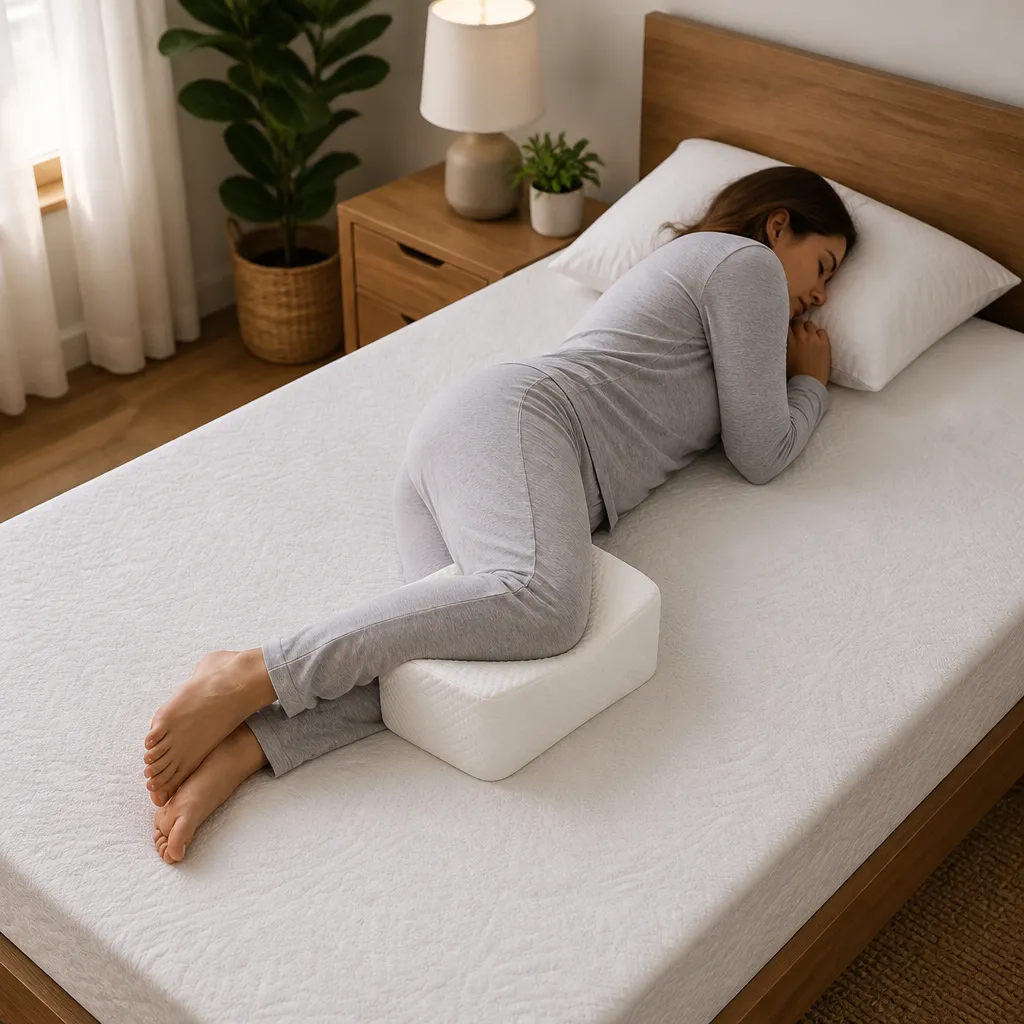
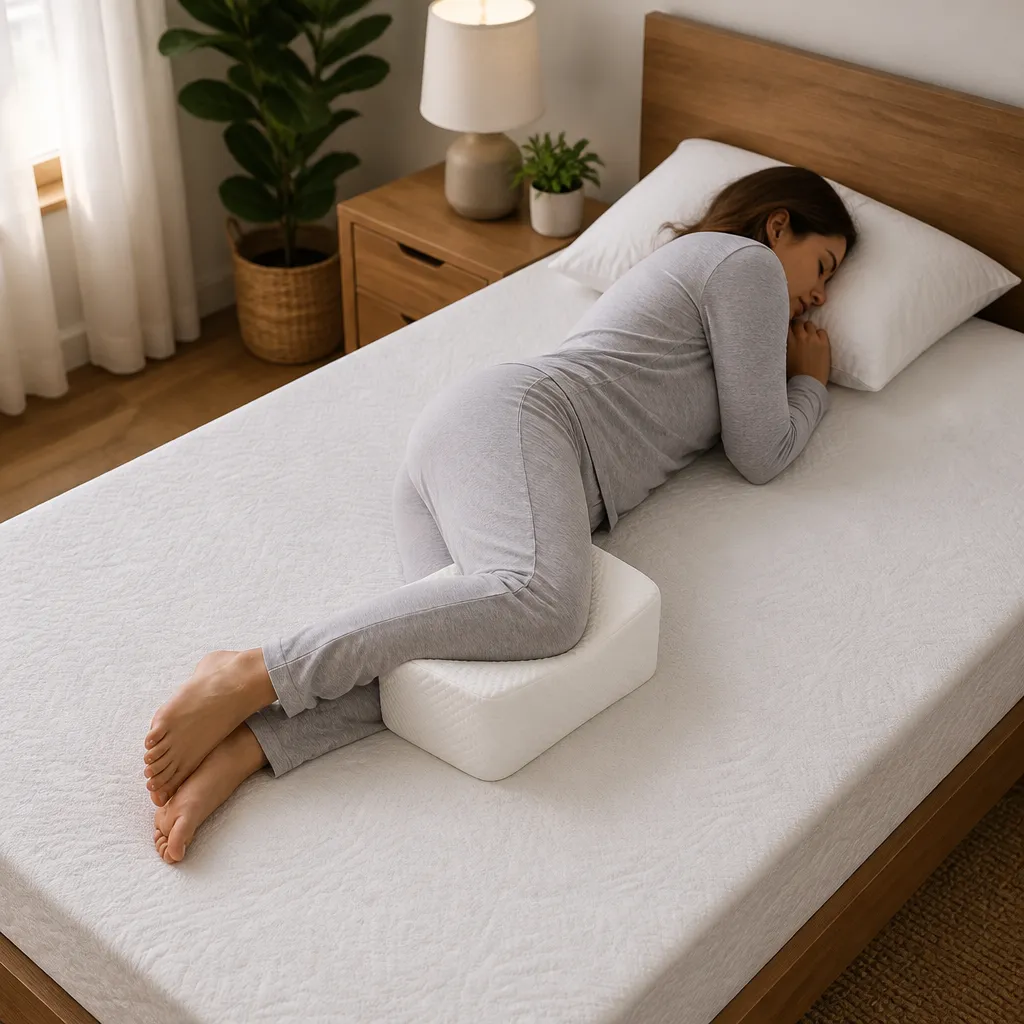
Side sleeping is the most common position in our showroom conversations, and it is the one that causes the most trouble when done without support. When one knee rests directly on the other, pressure builds where the two knees meet. At the same time, the upper leg can fall forward, which twists the knee joint as you sleep. Advanced Ortho Sports describes this exact pattern as a frequent cause of side-sleeper knee pain.
The fix is simple and cheap. Place a firm pillow between your knees so the upper leg rests on the pillow instead of the lower knee. Keep the knee gently bent rather than locked straight, since a slight flex reduces strain on the joint.
Pro tip: Hug the pillow with your top arm, and keep it thick enough that your knees do not touch when you roll toward the edge of the bed.
Back sleeping with straight legs
Back sleeping can be gentle on the knees, but only if the legs are supported. Orthoep recommends placing a pillow under the knees when you sleep on your back, which keeps the joint in a relaxed, slightly bent position. Without that support, the back of the knee can stay stretched for hours, and the lower back often tightens as well.
Keep the support low and modest. A pillow that is too high can push the hips forward and create new pressure in the lower back. A gentle bolster or a rolled towel works well for many people, and it stays in place better than a stack of pillows.
Stomach sleeping and the twisted joint
Stomach sleeping is the position we discourage most. It usually leaves one knee bent and rotated for hours, and it often turns the hips and lower back in the same direction. Fondren’s sleep guidance focuses on keeping a joint supported and preventing it from twisting overnight, and stomach sleeping works against both goals.
If you cannot break the habit quickly, place a thin pillow under the hips and lower abdomen to reduce the twist. Then work gradually toward side or back sleeping, since a slow change is easier to maintain than an abrupt one.
Mattress Firmness and Knee Support
Firmness gets far more attention than it deserves in mattress shopping, and far less attention than it needs in knee pain. A mattress is not comfortable simply because it feels soft in the showroom. It needs to hold your spine straight while letting your hips and shoulders settle enough to take pressure off the joints.
Why a sagging mattress twists your knees
When the middle of a mattress has worn down, the hips sink lower than the shoulders and the knees. The spine bends, the pelvis tilts, and the legs rotate to find a stable position. Each of those adjustments moves the knee a little out of its natural line. Over a full night, small rotations add up to stiffness and aching.
In practice, we see many customers who were sure their knees were the issue, only to discover a mattress with a deep dip in the center. Replacing that bed often reduces knee complaints faster than any change in pillows alone.
Why very firm beds hurt
A mattress that is too firm has the opposite problem. The hips and knees press into a hard surface, and the pressure concentrates on bony points rather than spreading out. Many people wake up after a few hours because the joints are tired of the same spot taking all the weight. Firm does not mean supportive, and a rock-hard bed can make joint pain worse.
Most nighttime knee pain is a positioning problem before it is a joint problem, and the mattress decides whether a good position can hold for the whole night.
Where medium-firm fits
NCOA’s review of mattresses for arthritis points toward a medium-firm feel, around 6 to 7 on a 10-point firmness scale, as a practical target. The reasoning is sound: a surface that is firm enough to keep the spine aligned and soft enough to cushion the joints is the balance most joint-pain sleepers need. NCOA’s reviewers also emphasized checking support at the neck, shoulders, and hips, not just the center of the bed.
Medium-firm is a starting point, not a guarantee. Your body weight, sleep position, and joint sensitivity all change the result. Still, if you are shopping without much guidance, medium-firm gives you the best odds of finding a bed that supports the knee without punishing it.
Materials, Cooling, and Spinal Alignment
Materials affect how a mattress supports the knee, how it distributes pressure, and whether you sleep hot. Many customers come to us wanting a bed that aligns the spine, reduces pain in the neck, shoulders, and hips, and keeps them cool through the night. Each material solves a different part of that puzzle, and the right choice depends on which problem is the most urgent for you.
Latex and steady support
Latex tends to feel responsive, meaning it pushes back as you move instead of wrapping around you. For people with knee pain, that responsiveness can make it easier to change position without strain. Latex also holds its shape well, which matters because a mattress that keeps its profile is less likely to develop the sag that twists the knees.
Latex can feel firmer than memory foam at first touch. Give it a full night before you judge it, and pay attention to whether your hips and shoulders feel supported rather than just whether the surface feels pleasant.
Memory foam and pressure relief
Memory foam is designed to contour around the body, which can relieve pressure on the hips, shoulders, and knees. Many side sleepers find that foam cushions the joints where bone meets surface. The tradeoff is that some foam mattresses hold heat and can sink too far if the core density is low.
If you choose memory foam, look for a model with enough density to keep your spine level. A deep impression that traps your hips is a sign the foam is too soft for your body weight. Our team can help you compare foam models side by side so you feel the difference rather than guessing from a brochure.
Sleeping cool without sacrificing support
Heat is a quiet cause of restless nights. Warm sleepers shift more often, and frequent movement can wake a joint that was finally settling down. Look for breathable covers, open-cell construction, or cooling layers if you sleep warm. Those features matter most when they are combined with the firmness and support needed to keep the knees comfortable.
Pro tip: Before you commit to a mattress, lie down in your usual sleep position for at least 10 minutes. Ask yourself whether your knees feel supported and whether your hips and lower back feel level.
Knee Pillows and Positioning Tools
A mattress sets the stage, but small tools make the biggest day-to-day difference for knee pain. Healthline’s guidance on nighttime knee pain highlights knee pillows, heating pads, and pain-relieving ointments as options many people find helpful. Used well, these tools support the knee while your mattress handles the rest of the body.
Knee pillows for side sleepers
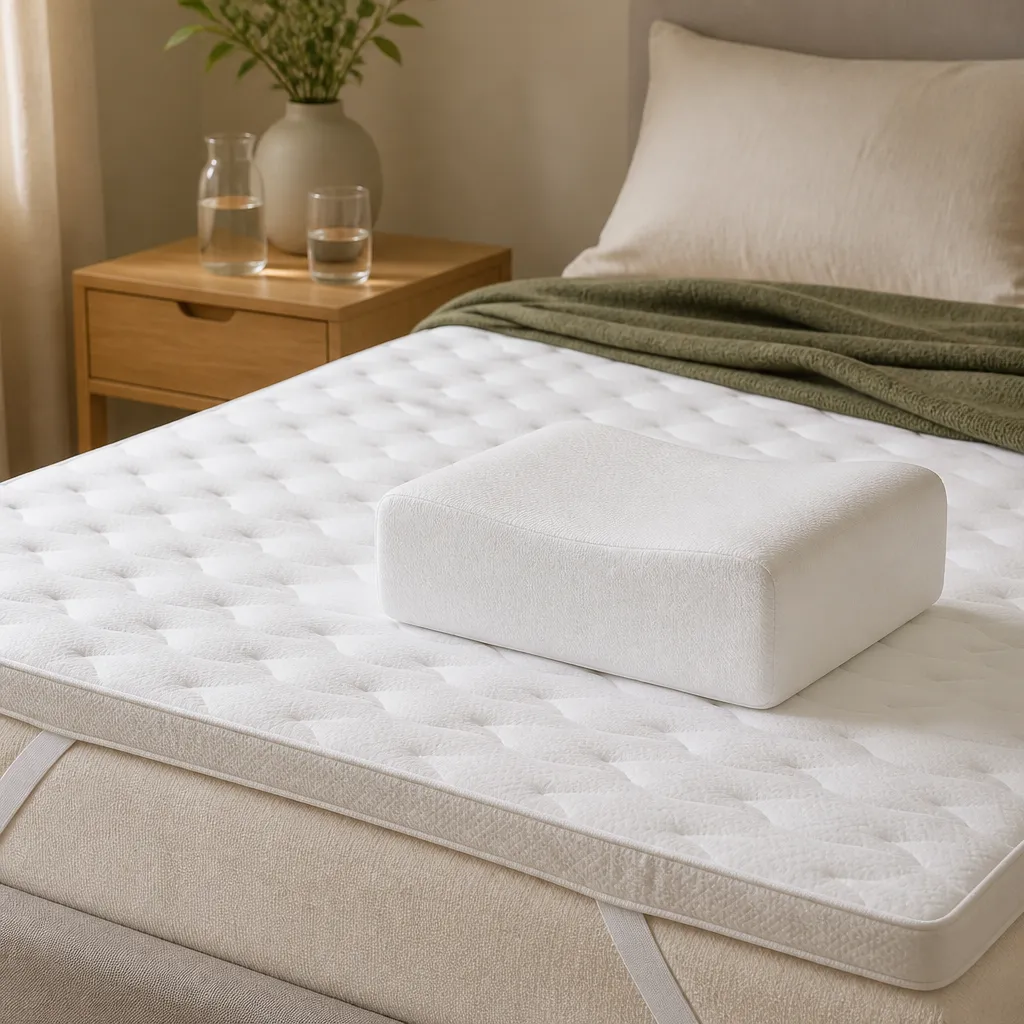
A contoured knee pillow is designed to sit between the knees and keep the upper leg from sliding forward. It is most useful for side sleepers who wake up with the top knee aching or the hip twisted. The shape matters more than the fabric, since a pillow that is too small slips out of place within an hour.
A standard bed pillow can work in an emergency, but it often flattens and drifts. If you rely on a pillow every night, a firmer, purpose-built model usually holds its position better and gives more consistent support.
Bolsters for back sleepers
Back sleepers often do best with a low bolster or a rolled towel under the knees. The goal is a slight bend that takes strain off the back of the knee without raising the hips. A bolster that is too thick can bend the knees too far and load the lower back, so start with a small support and adjust gradually.
Choosing among the options
The table below compares three common approaches. Each one has a place, and most people benefit from pairing a supportive mattress with one of these tools rather than relying on either alone.
| Option | Works Best For | Watch Out For |
|---|---|---|
| Contoured knee pillow | Side sleepers with a top knee that drops forward | Can slip out of place if it is too small or too soft |
| Standard bed pillow between the knees | Quick fix while you test positions or travel | Flattens and drifts, so support fades during the night |
| Low bolster or rolled towel under the knees | Back sleepers who wake with straight-leg stiffness | Too much height can strain the lower back |
Common Mistakes That Keep Knees Hurting
Most of the knee problems we discuss with customers come from habits rather than bad luck. People tend to make the same few mistakes, and they usually do not realize the mistakes are connected to their pain. Fixing those habits often gives faster results than buying a new accessory.
Stacking pillows until the neck and knee both misalign
Many people add pillows until their head feels comfortable, then wonder why their knees hurt. A tall stack lifts the head and bends the upper body, which changes how the spine and pelvis line up. That shift changes the angle of the knee too. Use one pillow that keeps your neck level, then add a separate knee support.
Keeping an old mattress past its useful life
A worn-out mattress is one of the most common hidden causes of joint pain. Look for visible sagging, a permanent body impression, or waking up stiffer than when you went to bed. If you have to readjust your position every hour to find relief, the bed may be asking to be replaced.
Expecting a new mattress to fix everything overnight
A new mattress needs an adjustment period. Your body may take a week or two to settle into a new surface, and some stiffness can linger while you adapt. Give the bed a fair trial, keep your pillow setup consistent, and track how you feel each morning rather than judging the mattress on the first night.
Pro tip: Keep a simple sleep log for two weeks. Note your sleep position, when the knee first aches, and how stiff you feel when you stand up. Patterns in that log will show you which change is helping.
Choosing a Mattress for Knee Pain
Choosing a mattress for knee pain is less about chasing a brand name and more about testing how the bed supports your body in the position you actually sleep. Our founders built our showroom around that idea: give customers time, honest information, and a bed that works for their body rather than one that simply looks good on a display floor. Shoppers in Orange County and Anaheim often tell us that a calm, no-pressure visit makes it easier to think clearly about their knees.

Test it the way you actually sleep
Lie down in your usual position for at least 10 minutes, and bring a pillow with you if you normally use one. Notice whether your hips settle without sinking, whether your shoulders feel supported, and whether your knees rest without pressing on a hard edge. A quick lie-down in a store is not a real test, but a focused trial in your usual position tells you much more.
Delivery windows and setup
Delivery matters more when you are sore. Heavy boxes, long waits, and unclear arrival times add stress to a body that is already uncomfortable. We offer exact day-and-time delivery windows, and most orders are typically delivered within 24 to 48 hours. NCOA’s review also notes that delivery and setup options matter when mobility is limited, so ask about setup before you buy.
Payment options when budget is tight
Budget and credit history should not decide whether you get a supportive bed. We offer no-credit-needed payment plans, along with a 3-month purchase option available in California. Ask our team to explain the terms in plain language before you sign anything, so you know exactly what you are agreeing to.
Frequently Asked Questions
Is a firm mattress always better for knee pain?
No. A mattress that is too firm can press on the hips and knees and create pressure points. Most people with joint pain do better with a medium-firm surface that supports the spine while still cushioning the joints.
Should I put a pillow between my knees if I sleep on my side?
Yes, in most cases. The pillow keeps the upper knee from resting on the lower knee and reduces the forward twist that can strain the joint. Choose a pillow thick enough that your knees stay separated through the night.
What sleep position is worst for knee pain at night?
Stomach sleeping is usually the hardest on the knees because it tends to keep one knee bent and twisted for hours. If you switch positions, do it gradually and use a support under the hips to reduce the twist.
How long should I test a new mattress before deciding it is wrong?
Give a new mattress one to two weeks. Your body needs time to adjust, and early stiffness does not always mean the bed is wrong. Track how you feel each morning, and if the pain does not improve, consider whether the firmness or support is the issue.
Can I get a supportive mattress without good credit?
Yes, our no-credit-needed payment plans are designed for shoppers with limited or no credit. We also offer a 3-month purchase option available in California. Review the terms with our team before you commit, so the plan fits your budget.
Can a mattress alone fix knee pain?
A mattress can make a significant difference, but it works best alongside good sleep positioning, a suitable pillow, and medical advice when pain is severe or persistent. If your knee swells, feels hot, or keeps you awake for weeks, see a healthcare provider.
If you have noticed that your knee pain changes with how you sleep, we would like to hear what has helped you, so please share your experience with our team when you visit our showroom or get in touch.
References
- Hartford HealthCare tips on adjusting sleep position for nighttime knee pain
- Healthline guide to knee pain at night and helpful sleep tools
- Orthoep advice on sleeping positions that reduce joint pain
- Advanced Ortho Sports explanation of knee pain when sleeping on your side
- NCOA review of mattresses for arthritis and joint pain