


What Is Mattress Coil Count and Does It Affect Lifespan?
If you have ever compared two spec sheets, you have probably noticed the mattress coil count listed as a headline number. It sounds impressive, and many shoppers assume more coils always means a better bed. In practice, coil count is only one piece of the picture, and on its own it tells you very little about how long a mattress will hold its shape. The construction of the coils, their thickness, and how they are arranged inside the mattress matter far more. This guide explains what coil count actually measures, where it misleads buyers, and what to check so an innerspring or hybrid mattress lasts years instead of months.
Table of Contents
- Quick Takeaways
- What Mattress Coil Count Actually Measures
- Why Coil Gauge Matters More Than Count
- Coil Types Compared Side by Side
- How Coil Count Affects Mattress Lifespan
- Warning Signs Your Coils Are Wearing Out
- Shopping Checklist for Orange County Buyers
- Matching Coil Design to Your Sleep Style
- Frequently Asked Questions
- References
Quick Takeaways
| Key Insight | Explanation |
|---|---|
| Coil count alone does not predict lifespan | Two mattresses with the same count can wear very differently if the steel gauge, coil type, or edge construction differs. |
| Compare count only within the same size | A California king needs far more coils than a twin, so a total only means something next to the same size listing. |
| Lower gauge means thicker, firmer wire | Heavier sleepers usually need a lower-gauge support core because thin wire compresses and sags faster under repeated load. |
| Pocketed coils reduce motion transfer | Individually wrapped coils move independently, so a partner rolling over is less likely to wake you. |
| A well-made coil mattress can last up to 10 years or more | That range assumes sound construction and a firm, fully supported foundation. Poor builds fail well before that point. |
| Ask for coil type, gauge, and comfort layers together | These three details reveal far more about durability than the coil total printed on the label. |
What Mattress Coil Count Actually Measures
Mattress coil count is the total number of metal support coils in the innerspring unit, and it is usually listed for a specific size. A queen and a California king from the same manufacturer will have different totals because larger sizes need more coils to cover the surface. That is why the number only makes sense when you compare the same size side by side.

Coils are the metal springs that form the core of an innerspring or hybrid mattress. They absorb pressure as you lie down and push back to keep your spine level, and they shape how the bed feels from the first night. Most are made from tempered steel, a heat-treated metal that keeps its shape through years of compression.
Why count changes with mattress size
A California king innerspring can list well over 700 coils, while a twin will have a much smaller total. Those numbers tell you about surface coverage, not automatically about quality. In practice, a buyer should first confirm the size, then look at the count, then move on to the details that actually predict wear.
What the count does not tell you
Count says nothing about the steel quality, the shape of each coil, or how the coils are tied together. Two mattresses with identical totals can feel and wear very differently. Coil type and build quality affect comfort more than the raw number does.
Pro tip: Write the gauge and coil type next to the count when you compare listings. A 700-plus count with thin wire can lose to a lower count built with thicker steel.
Why Coil Gauge Matters More Than Count
Gauge refers to the thickness of the steel wire used to make each coil. A lower gauge number means thicker wire, which produces a firmer and more durable coil. Higher-gauge coils are thinner and softer, which can feel comfortable at first but often compresses faster under repeated load.
Coil gauge and coil quality tell you more about how a mattress will hold up than the total number of coils printed on the label.
How gauge affects heavier sleepers
Heavier sleepers put more force on each coil, so they benefit most from thicker wire. A lower-gauge support core usually holds its shape longer under a heavier body. Thin wire in the same spot can start to dip night after night, and that dip is what turns into persistent back pain.
Lighter sleepers can often use a softer, higher-gauge feel without the same risk. The key is matching the steel to the load it will carry for a decade, not just the first month.
Where gauge hides on the spec sheet
Manufacturers do not always list gauge, and when they do, it may be buried in a long construction paragraph. Ask for it directly. A seller who knows the product should answer in seconds, and a vague reply is a signal to keep shopping.
Our founders spend time on exactly these details with every customer, because no one should have to guess at the steel inside a mattress they will sleep on for years.
Coil Types Compared Side by Side
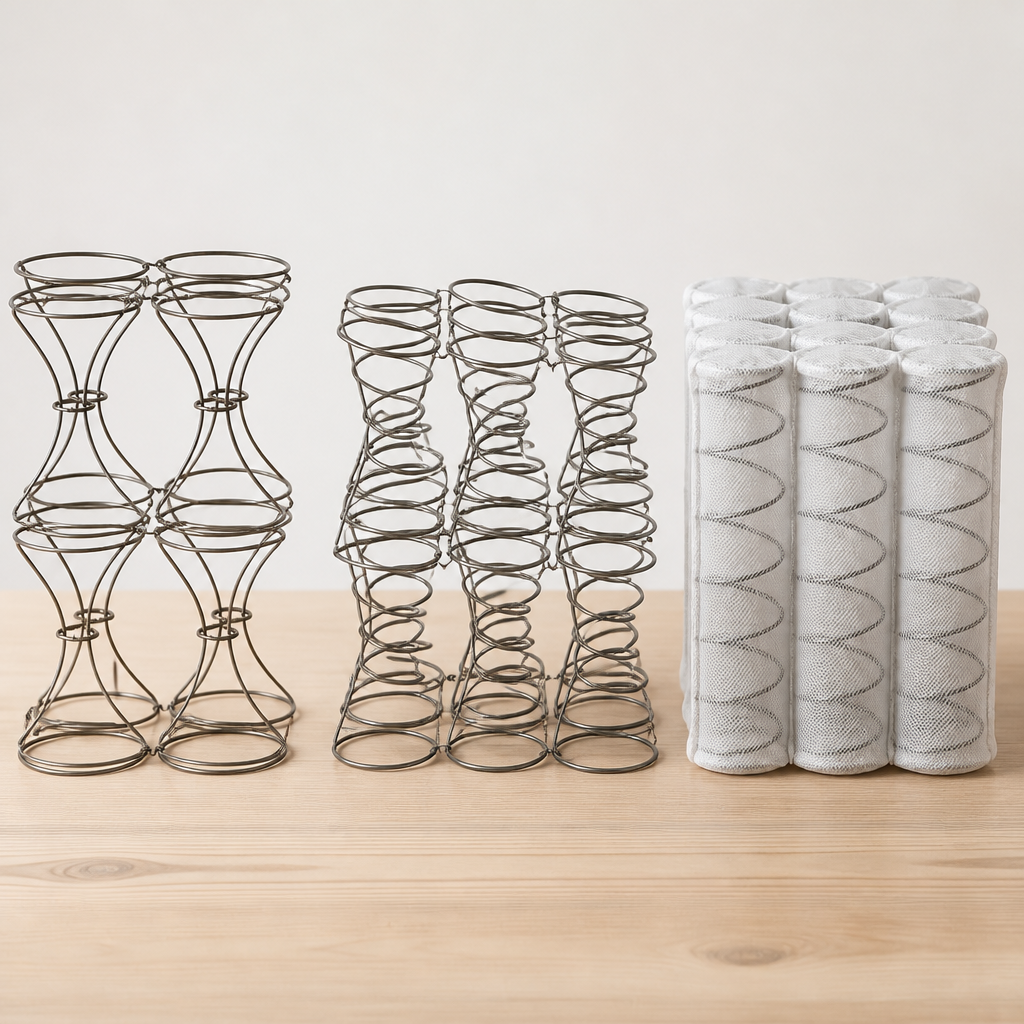
The four main coil systems are Bonnell, offset, continuous wire, and individually wrapped, also called pocketed coils. Each one offers a different balance of support, motion control, and durability. Knowing the coil type tells you more about everyday feel than the count does.
Bonnell coils and their trade-offs
Bonnell coils are the oldest and most basic design, and they are linked together with helical wire. They are affordable and breathable, which is why they remain common. Because the coils are connected, pressure in one spot can travel across the surface, so motion transfer is more noticeable.
Pocketed coils for motion control
Individually wrapped coils sit in their own fabric pockets and respond independently. Sleepers who share a bed often prefer this design because one person’s movement is less likely to reach the other. Pocketed coils are also favored for more targeted support across the body.
| Coil Type | Motion Transfer | Durability Notes |
|---|---|---|
| Bonnell | Higher, because coils are linked | Affordable and breathable, but cheaper versions with thin wire can sag sooner |
| Offset | Moderate | Ask how the edges are built, since perimeter support strongly affects how long the bed keeps its shape |
| Continuous wire | Moderate to higher | One wire forms the whole core, so the gauge of that wire is the key figure to check |
| Individually wrapped (pocketed) | Lowest | Each coil wears on its own, so the quality of the fabric pockets and the steel both matter |
How Coil Count Affects Mattress Lifespan
Lifespan depends on how load is spread across the coils and how well the steel holds up over time. A higher count can help distribute weight more evenly, because each coil carries a smaller share of the load. Past a certain point, however, extra coils made from thin wire do not add real durability.
Load distribution and sagging
When each coil carries less load, it compresses less, which helps reduce localized sagging. The mattress still needs a sound support core and a sturdy perimeter, so count works alongside gauge rather than replacing it. A good count with a weak core will still develop a hollow.
In practice, the first place a mattress shows wear is the zone where most of your body weight sits, usually the mid-torso to hip area. That is where the coil system needs the most reliable steel.
Realistic lifespan expectations
A well-made coil mattress can last up to 10 years or more, but that is the top of the range, not a guarantee. Heavy use, a poor foundation, and thin gauge all shorten that window. We tell buyers to plan around a decade for a solid build and to question any product with a much shorter expected life.
Pro tip: Use a firm, fully supported foundation with your coil mattress. Uneven or sagging bases put stress on the coils, which can shorten the life of even a well-built mattress.
Warning Signs Your Coils Are Wearing Out
Coils rarely fail all at once. They lose support gradually, and most sleepers adjust to a sagging bed without noticing until back, hip, or shoulder discomfort shows up. Knowing what to look for lets you act before the damage becomes harder to fix.
A dip that stays after you get up
A dip that remains after you stand up, or a visible hollow in the spot where you usually sleep, means the coils in that zone have lost their pushback. Rotating the mattress can slow the process, but it cannot restore coils that have already taken a permanent set. Check the dip against a straightedge laid across the surface to see how deep it really is.
Squeaks, edge roll, and uneven feel
Squeaking often points to coils rubbing or loosening inside the support core. Edge roll-off, or a bed that feels lower on one side, suggests the perimeter support is fading. Either sign is worth a professional look before you decide whether to repair, rotate, or replace.
A common mistake is waiting until the bed feels unbearable. By then the foundation and the coils have usually been stressed for a long time, and the wake-up pain has already become a habit.
Shopping Checklist for Orange County Buyers
Most buyers in Orange County want a mattress that lasts without paying top-shelf prices. Start with the same five checks every time: size-matched coil count, coil type, support gauge, comfort layers, and warranty terms. Work through them in that order, and the price comparison becomes much clearer.
Questions to ask before you buy
Ask for the coil type, the gauge of the support coils, and what sits above them. A seller who can explain those details in plain language usually knows the product well. If the answers are vague or rushed, that is a good reason to keep looking.
Also ask how the mattress is built at the edges, since a strong perimeter helps the whole bed hold its shape for years.
How budget and payment plans fit in
Durability is not only about the price tag. We offer no-credit-needed payment plans, including a 3-month purchase option available in California, so you can choose a better-built coil mattress now instead of settling for a thinner one. Our showroom in Orange County has no commissioned sales associates, so you get one-on-one attention without pressure to upgrade.
Most orders are typically delivered within 24 to 48 hours, and you can choose an exact day and time window for delivery in Anaheim and across Orange County.
Pro tip: Measure your bed frame and confirm the exact size before comparing coil counts. The same model can list very different totals across sizes, and a mismatch makes the comparison meaningless.
Matching Coil Design to Your Sleep Style
The right coil design depends on how you sleep, who shares the bed, and how warm you tend to run at night. Coil systems allow air to move through the core, which is one reason innerspring mattresses are known for sleeping cool. That airflow matters for people who wake up overheated.

Side sleepers and pressure points
Side sleepers need enough give at the shoulder and hip to keep the spine aligned without sinking too deep. A softer comfort layer over a well-built coil core often works well here. Good support can reduce pressure points for many sleepers, but a mattress is not a medical treatment, so persistent pain should be checked by a clinician.
Couples and motion control
If you share a bed, pocketed coils are usually the better choice because they isolate movement. Bonnell coils are more affordable but transmit motion across the surface more readily. Test the mattress with a partner lying in the bed, then have them shift position while you watch for the bed moving at the other side.
Staying cool on a coil core
Air moving through the coil system helps carry heat away from the body, which keeps many sleepers more comfortable through the night. Pair the mattress with breathable bedding, and avoid heavy foam toppers that trap heat if you tend to sleep warm.
Frequently Asked Questions
Is a higher mattress coil count always better?
No. A higher count only helps when the coils are made from sound steel and arranged well. Gauge, coil type, and perimeter construction usually predict durability more reliably than the total number alone.
How many coils should a queen mattress have?
There is no universal number because each manufacturer designs its core differently. Compare queen models against each other, and weigh the count alongside gauge and coil type.
Does coil gauge matter more than coil count?
For durability, gauge usually matters more. Thicker, lower-gauge wire resists sagging under repeated load, while a high count made from thin wire can still wear out quickly.
How long should an innerspring mattress last?
A well-made coil mattress can last up to 10 years or more. Heavy use, a poor foundation, or thin support coils can shorten that lifespan considerably.
Can I buy a quality mattress without good credit?
Yes. We offer no-credit-needed payment plans, including a 3-month purchase option available in California, so you can choose a durable coil mattress without a credit check.
Are pocketed coils worth the extra cost for couples?
In many cases, yes. Individually wrapped coils reduce motion transfer, so one partner’s movement is less likely to disturb the other during the night.
We would love to hear your experience, so tell us which warning sign made you replace your last coil mattress or what question you still have about coil count.