

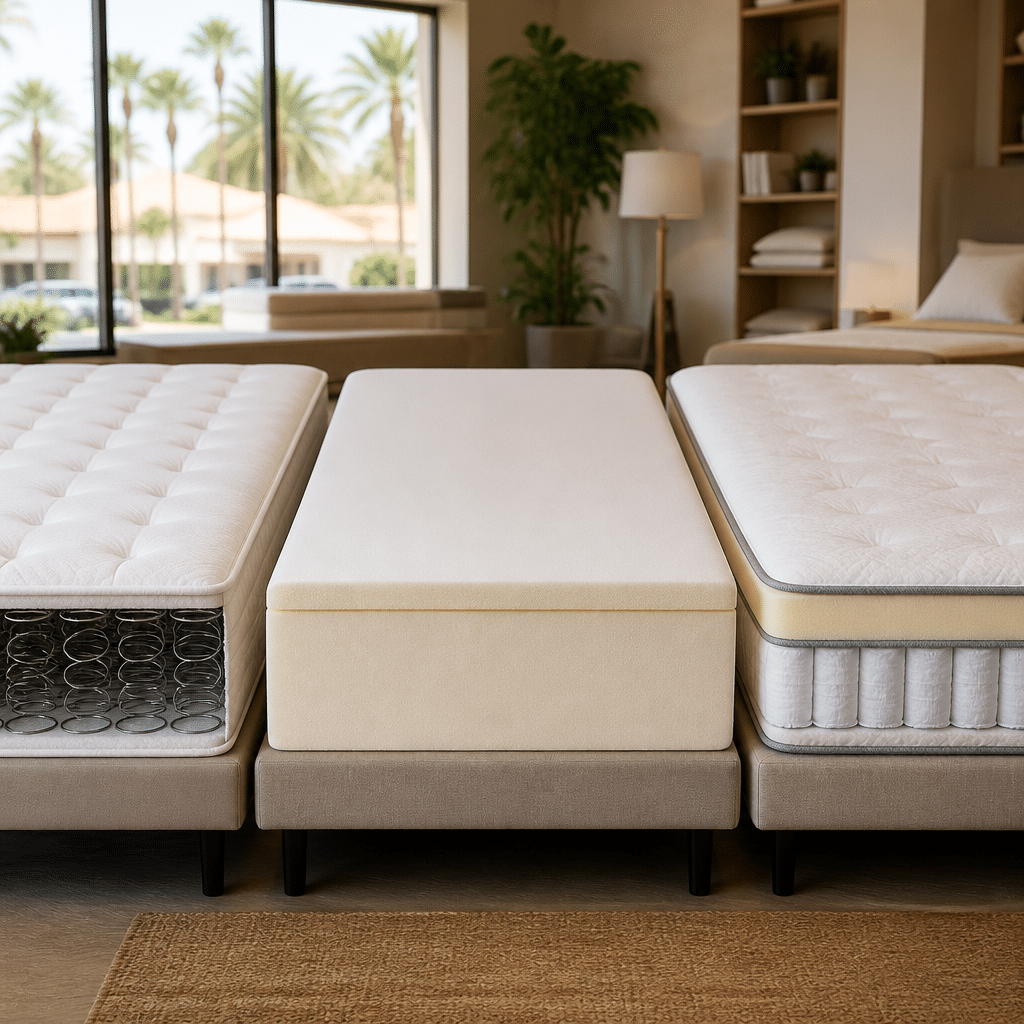
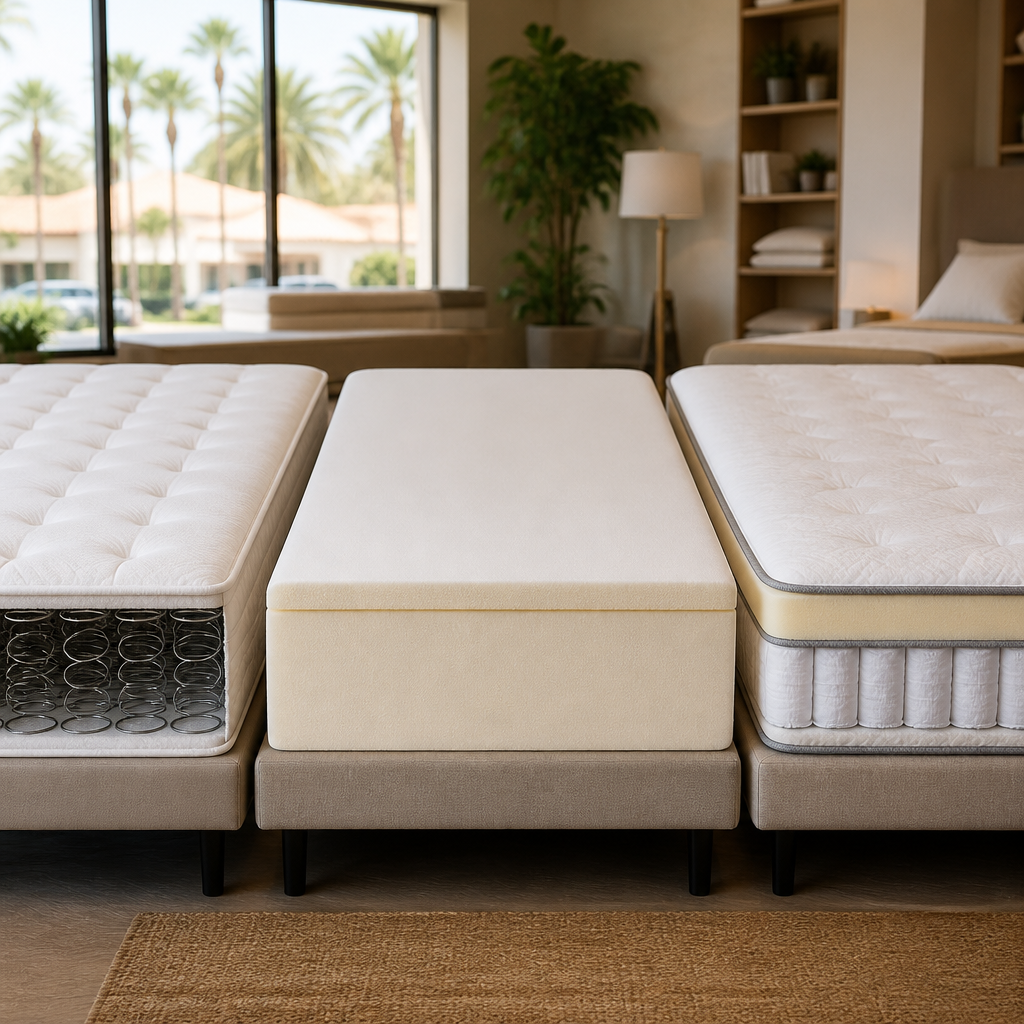
Innerspring vs Foam vs Hybrid: Orange County Buyer’s Guide
Walk into almost any mattress showroom and you will hear three words within minutes: innerspring, foam, and hybrid. Each one promises a good night’s sleep, and each one feels different once you lie down. The labels alone tell you very little about support, temperature, or how long the bed will hold its shape. For Orange County shoppers on a real budget, that gap matters, because a mattress that sags after two years costs more than the one that was a little pricier at the start. This guide breaks down the innerspring mattress, the foam mattress, and the hybrid mattress in plain language so you can choose without sales pressure.
Table of Contents
- Quick Takeaways
- What Is an Innerspring Mattress?
- What Is a Foam Mattress?
- Hybrid Mattresses: Coils With a Foam Comfort Layer
- Side-by-Side Comparison
- Back, Neck, Hip, and Shoulder Pain
- Sleeping Cool Through the Night
- Buying a Mattress in Orange County
- Frequently Asked Questions
- References
Quick Takeaways
| Key Insight | Explanation |
|---|---|
| Innerspring suits shoppers who want bounce | Steel coils push back under you and usually allow more airflow than solid foam. Expect less contouring at the shoulders and hips. |
| Foam is the pressure relief pick | Memory foam conforms to the shoulders and hips, but it can hold heat and feels slower to change position on. |
| Hybrids are the compromise most couples need | Individually wrapped coils sit under a foam comfort layer, typically at least 3 inches thick, so you get support and contour together. |
| Lower coil gauge means a firmer feel | Mattress coils typically range from 12 to 15 gauge. A 15-gauge coil feels softer than a 12-gauge coil. |
| Flip rules differ by type | Some innersprings have two sleep sides, but hybrids are usually one-sided. Check the label before you plan to flip or rotate. |
| Foam density decides how long it lasts | Low-density foam breaks down sooner than higher-density foam, even when both are the same thickness. |
| Payment plans should not force a cheap choice | No-credit-needed payment plans and a 3-month purchase option in California let you buy the right type instead of the cheapest one. |
What Is an Innerspring Mattress?
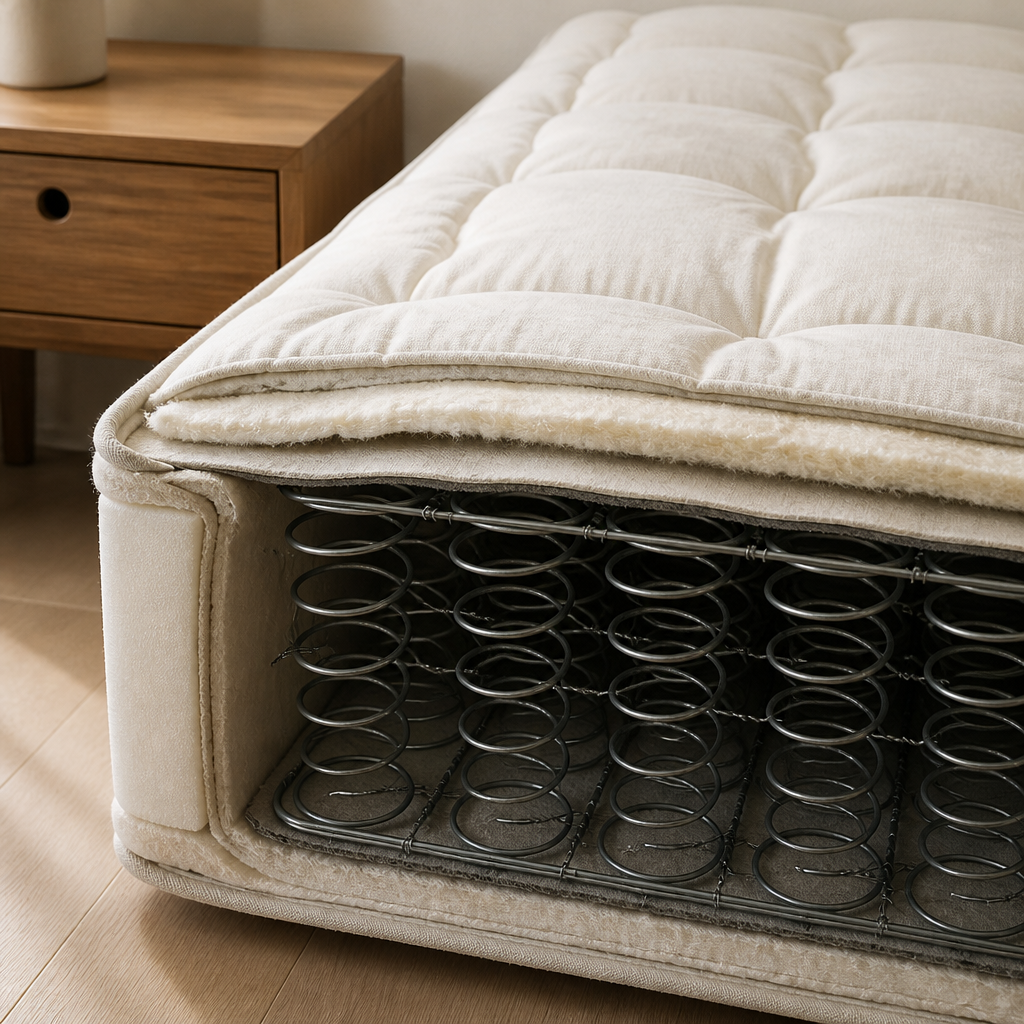
An innerspring mattress is the traditional design most people picture when they hear the word mattress. Its support comes from a core of steel coils, usually lined up in rows across the sleep surface. In most models, the coils make up almost the full height of the mattress, with a thin comfort layer on top.
In practice, the coil system determines how the bed feels and how it wears. The coils respond as you change position through the night, which is why a well-built innerspring feels responsive when you roll over. Many innerspring models are simply the classic design with a light layer of foam or padding on top, so the coils do most of the work.
Coil Gauge and What It Means for Firmness
Coil gauge refers to the thickness of the steel wire. The lower the gauge number, the thicker the wire and the firmer the coil, so a 12-gauge coil feels firmer than a 15-gauge coil. Steel used in mattress coils typically runs from 12 to 15 gauge.
Shoppers often judge firmness by the top layer alone. The coil gauge sets the base feel underneath, and a soft comfort layer cannot fully fix a coil core that is too firm or too soft for your body weight. Ask what gauge the coils are before you decide based on the surface.
Bonnell, Offset, and Continuous Coils
Bonnell coils are hourglass-shaped springs used throughout the mattress, a classic design with a long track record. Offset coils are also hourglass-shaped, but they are connected at the top and bottom and set very close together, which makes them durable. The trade-off is that connected springs can still carry motion from one side of the bed to the other.
Continuous coils are formed from a single long wire bent into a zigzag pattern that runs through the unit. Each design balances durability, motion control, and cost differently, so the coil type is worth asking about before you compare prices.
Pro tip: If a partner tosses and turns, ask specifically whether the coils are individually wrapped or connected. Individually wrapped coils isolate movement far better than a fully connected system.
What Is a Foam Mattress?
A foam mattress is built from layers of polyurethane foam, and memory foam is the most common comfort material. Memory foam responds to heat and pressure, so it softens where your body presses and slowly returns to shape when you move. That is the core difference between foam and a coil bed.
The contour is the main reason people choose foam. Shoulders and hips sink in slightly, which takes pressure off the points that often ache for side sleepers. Foam also absorbs partner movement well, so a restless sleeper disturbs the other person far less than they would on a connected coil system.
How Memory Foam Relieves Pressure
Pressure relief is the strongest argument for foam, especially if you sleep on your side. Foam spreads your weight over a wider area, which is why many people wake up without the numbness that a firm surface can cause at the hip and shoulder. The effect is most noticeable in the first few weeks as the foam settles.
The downside is heat. Dense foam holds warmth close to the body, and a memory foam bed can feel warm to people who run hot, especially during warm Southern California months. Foam that sinks too far can also make it harder to change position during the night.
Density Decides How Long Foam Lasts
Density, measured as weight per cubic foot, matters more than thickness when you judge foam quality. Low-density foam compresses and develops body impressions sooner, even when the mattress looks thick enough on paper. Thickness alone tells you almost nothing about how the bed will feel in year three.
Ask for the density of each foam layer, and be wary of any bed that quotes only total height. A thick top layer of low-density foam is a common reason a mattress looks fine in a showroom and feels flat within a couple of years.
Pro tip: Lie on the foam in your usual position for at least 10 minutes. Foam often feels soft in the first minute, and that initial give can hide how it will feel after a full night of sleep.
Hybrid Mattresses: Coils With a Foam Comfort Layer
A hybrid mattress combines a coil support core with a thick comfort layer of foam. It keeps the bounce and airflow of coils and adds the contour of foam on top, which is why it has become the middle path for many shoppers. Hybrids are the category most people end up asking about once they compare the other two.
In hybrids, individually wrapped coils are almost always used. The coils are shorter than those in a traditional innerspring because the foam takes up part of the height. The coils handle structure while the foam handles pressure relief.
Why Hybrids Are Usually One-Sided
Many shoppers assume every mattress can be flipped to extend its life. Hybrids are generally built as one-sided beds, because the comfort foam sits on top of the coil system and the design does not expect the sleep surface to change sides. Flipping one can damage the foam layer and the feel.
That means you should plan on rotating a hybrid rather than flipping it, and only if the maker allows it. Some innerspring models do have two sleep sides, so check the label before you assume a bed can be turned over.
The Foam Layer That Separates a Hybrid From a Coil Bed
A hybrid typically carries at least 3 inches of memory foam. An innerspring usually has less than about 2 inches of foam, if it has any. That difference is what separates a true hybrid from a coil bed with a thin pad on top.
Foam thickness only helps if the foam is dense enough and the coils are supportive enough. A thick but soft hybrid can sag in the middle, while a firm coil core under thin foam will feel like an innerspring with a light cushion.
Pro tip: Press along the edges of a hybrid when you test it. Edge support decides whether you can sit on the side of the bed to put on shoes without the surface dropping under you.
Side-by-Side Comparison
The table below shows where each type earns its price and where it cuts corners. Use it as a starting point, then test the mattress you are considering in your own sleep position.
| Type | Strengths | Trade-offs |
|---|---|---|
| Innerspring Mattress | Bouncy feel, strong airflow, and usually a lower price at the same size | Less pressure relief at the hips and shoulders, and connected coil systems can carry motion across the bed |
| Foam Mattress | Strong contour, pressure relief, and good motion isolation | Can trap heat, and quality depends heavily on foam density |
| Hybrid Mattress | Combines coil support with a foam comfort layer, suiting mixed sleep positions | Usually costs more than a basic innerspring and is one-sided in most designs |
Among the shoppers we help, hybrids often make the most sense for couples, because they handle mixed sleep positions and different body weights. A single sleeper who wants the lowest price may be better served by a well-built innerspring. The right answer depends on who sleeps in the bed and how they move during the night.
Back, Neck, Hip, and Shoulder Pain
Pain relief from a mattress comes down to alignment and pressure. The goal is a surface that keeps the spine reasonably level while letting the shoulders and hips settle without forcing them out of line. Neither the firmest nor the softest bed is automatically the right one.
Wirecutter’s guide to mattresses for back pain notes that the experts it spoke with recommended a medium-firm mattress, moving away from the older advice to choose an ultra-firm slab. That shift matches what we see in practice, where too much firmness often creates pressure points at the hip and shoulder.
The firmest mattress in the store is rarely the right answer for back pain. A surface that keeps your spine level while letting your shoulders and hips settle usually wins.
Side Sleepers and Hip Pressure
Side sleepers need enough give at the shoulder and hip to keep the spine straight. A foam or hybrid comfort layer with moderate contour usually suits this position better than a firm coil core with a thin pad. If your hips ache by morning, the surface is often too firm at the pressure points.
AARP’s guide to mattresses for back pain named a memory foam model as a top performer for hip and back pain, citing its pressure relief and spinal support. That is one reason foam often ranks well for side sleepers, although the result depends on the specific foam and its density.
Back Sleepers and Neck Support
Back sleepers need the lower back supported so it does not arch into a gap. A medium-firm hybrid or a firm-leaning innerspring often works, but the pillow matters as much as the mattress. The mattress should hold the spine level while the pillow fills the space at the neck.
Neck pain is often a pillow and mattress combination problem. If the mattress is too soft, your head drops below the line of the spine when you lie on your back, and that strain builds up over weeks.
Pro tip: Test in your usual position with the pillow you sleep on at night. A showroom test without your own pillow can mislead you about neck alignment.
Sleeping Cool Through the Night
Heat is the most common complaint about foam, and it is the reason hot sleepers often end up disappointed with a memory foam bed. Dense foam holds body heat, while the open structure of a coil core lets air move through the mattress.
That does not mean innersprings are automatically cool. Airflow depends on the coil layout, the comfort layers, and the cover fabric. A thick pillow top on any type can hold heat, so look at the whole build rather than the type alone.
Airflow Through the Coil Layer
Coils create open space under the comfort layer, which helps air circulate. A hybrid gets part of this benefit because the coil core sits beneath the foam, though the foam still sits close to your body and adds warmth.
If you sleep hot, ask whether the foam is open cell or closed cell. Open-cell foam generally breathes better than denser closed-cell foam, which makes it a better fit for warm sleepers.
Cover Fabric and Top Layer Choices
The cover is the first layer your body touches, so it shapes how warm the bed feels in the first hour. Breathable knit covers generally feel cooler than tight, heavily quilted tops that trap air close to the skin.
Your bedroom matters too. Orange County homes can run warm, even with air conditioning, so a mattress that stays comfortable to the touch deserves attention alongside firmness and support.
Pro tip: Before you buy, rest your hand flat on the cover for a full minute. The warmth you notice in a showroom usually gets worse over a full night’s sleep.
Buying a Mattress in Orange County
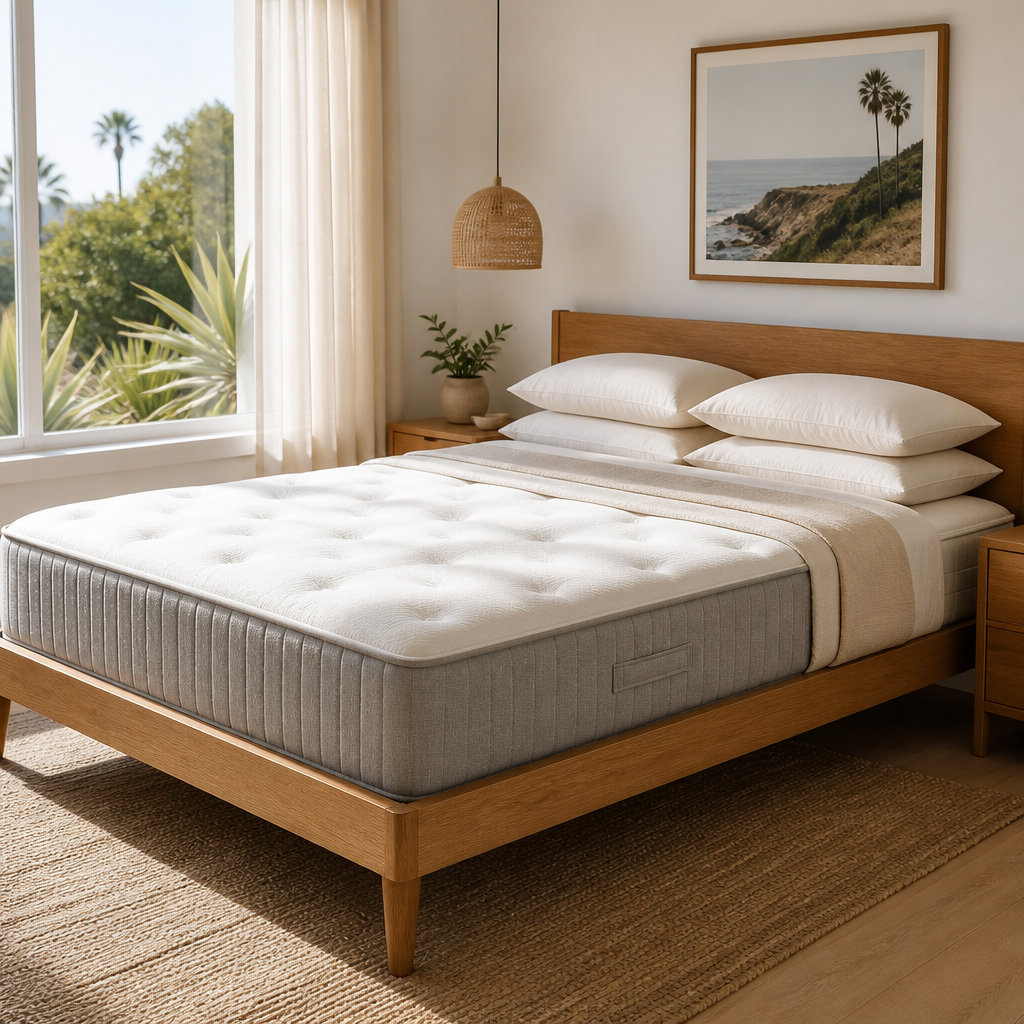
Our showroom is small on purpose. We are a husband-and-wife team focused on personal attention rather than pressure, and we do not use commissioned sales associates who push you toward the most expensive bed. You can test each type at your own pace, and the conversation stays focused on your body and your budget.
Start with two or three types, lie on each one, and bring the person who will share the bed. We also help with furniture and interior design, so you can match the mattress to the rest of the bedroom rather than buying each piece in isolation.
Payment Plans Without a Credit Requirement
Many shoppers want a better mattress but do not have the credit history to finance one through a traditional route. Our no-credit-needed payment plans are built for that situation, and a 3-month purchase option is available in California.
A payment plan only helps if the mattress fits your body. Pick the type that matches your sleep position first, then decide how to pay for it.
Delivery Windows and Setup
Most orders are typically delivered within 24 to 48 hours, and you choose an exact day and time window. That matters when you are balancing work shifts, school runs, or a bedroom that needs to be cleared first.
Remove the old mattress and check the foundation before delivery day. A new hybrid on a sagging base will not perform the way it did in the showroom, and the problem often gets blamed on the mattress.
Pro tip: Measure doorways, hallways, and tight corners before you choose a hybrid or foam mattress. Thicker beds can be harder to maneuver around turns in older homes.
Frequently Asked Questions
Which type is best for a tight budget?
A well-built innerspring usually costs the least at a given size, so it is often the starting point for a tight budget. Check the coil gauge and the comfort layer so you are not paying for a thin, short-lived top. We can show you the options side by side in the showroom.
Is an innerspring mattress good for back pain?
It can be, as long as the coils are supportive and the comfort layer is thick enough to cushion the shoulders and hips. A medium-firm feel is a common starting point. A thin pad on a firm coil core often creates pressure points for side sleepers.
Do foam mattresses sleep hot?
Many do, because dense foam holds body heat close to the sleeper. Look for breathable cover fabrics and foam with an open-cell structure, and rest on the surface for several minutes before you decide.
Are hybrid mattresses worth the extra cost?
For many couples and mixed sleep positions, yes. A hybrid gives you coil support, airflow, and a foam comfort layer that is typically at least 3 inches thick. A single sleeper on a strict budget may be better served by a basic innerspring.
Can I buy a mattress on a payment plan if I have no credit?
Yes. We offer no-credit-needed payment plans, and a 3-month purchase option is available in California. Confirm the terms in writing before you sign, and choose the type that fits your body first.
How long should I test a mattress before buying?
Lie in your usual sleep position for at least 10 minutes, and longer if you can. Bring your own pillow, and if you share the bed, test it together so both of you can judge the feel.
Tell us in the comments which type you sleep on now and what it has done well or badly for your back, neck, hips, or temperature.
References
- AARP guide to mattresses for back pain and pressure relief
- NCOA guide to the best mattresses for back pain
- Wirecutter guide to firmness advice for back pain mattresses