

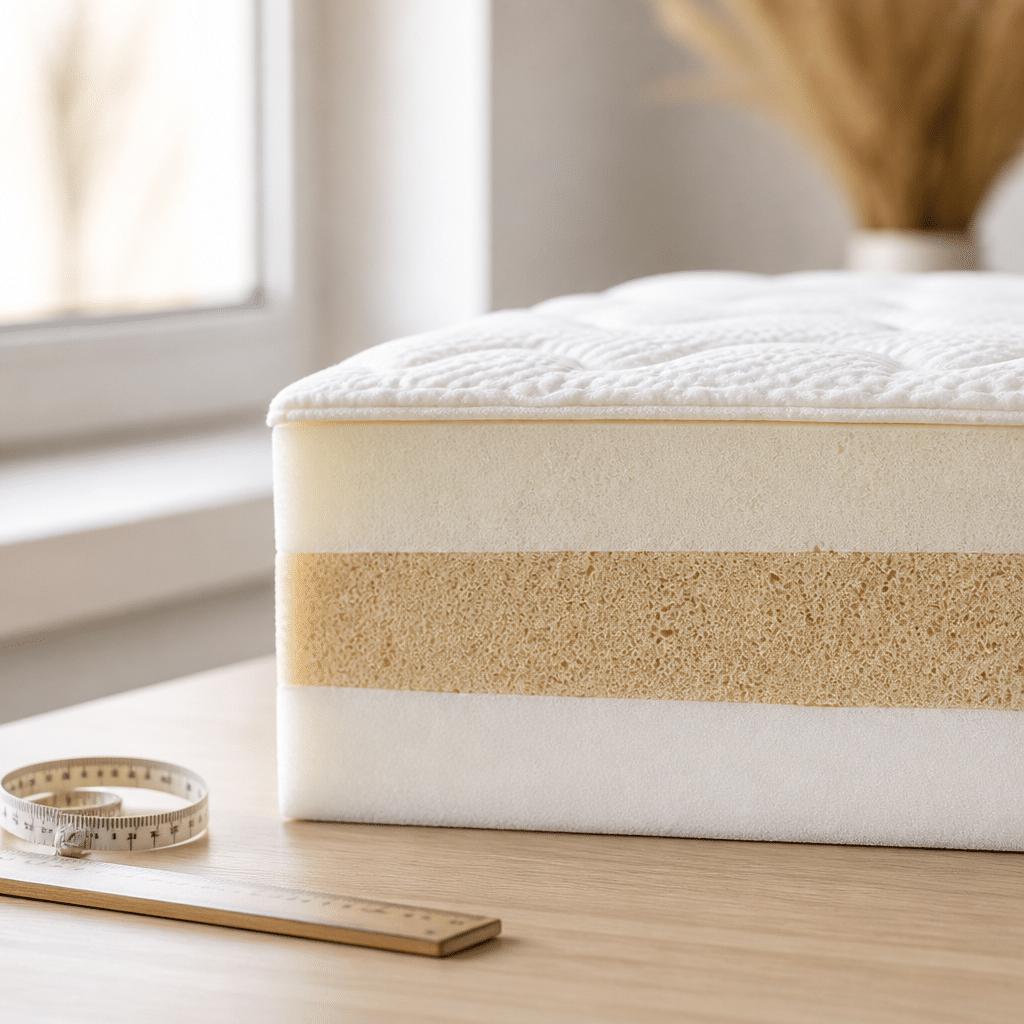
Why Memory Foam Density Is the Number That Matters Most
Ask most shoppers what makes a memory foam mattress good and they will point to feel, price, or the brand on the tag. Those things matter less than one number that most sales floors never explain: memory foam density. Density tells you how much foam is packed into a given volume, and it predicts how a mattress will hold its shape after years of nightly use. In our Orange County showroom, customers often arrive with a budget and a back that hurts. The first question we answer is not about color or style. It is about how much foam is actually under them.
Table of Contents
- Quick Takeaways
- What Memory Foam Density Actually Measures
- Density Versus Hardness: Why One Number Is Not Enough
- Density Ranges for Real Sleepers
- Durability and Cost Per Year of Sleep
- Comparing Three Memory Foam Builds
- Cooling Gel Layers and Density
- Shopping for Memory Foam in Orange County
- Frequently Asked Questions
- References
Quick Takeaways
| Key Insight | Explanation |
|---|---|
| Density is weight per volume | Higher density means more foam material in each cubic measure, which generally means more durability and better resistance to sagging. |
| Ask for the number in writing | Many sellers quote only a firmness word like “plush” or “medium.” Request the density and hardness figures for the comfort layer before you compare beds. |
| Know which unit you are reading | Some sources use kilograms per cubic metre, while many American sellers use pounds per cubic foot. Convert the two before comparing any spec sheets. |
| Density is not firmness | A dense foam can still feel soft if its hardness rating is low. You need both numbers to predict how the bed will feel and how long it will last. |
| Aim medium to high in the comfort layer | For most adults, a comfort layer below the middle density band compresses and does not spring back, and the spinal support you paid for fades within a few years. |
| Compare cost per year, not sticker price | A denser mattress that lasts years longer can cost less per year of sleep than a cheaper bed you replace early. |
What Memory Foam Density Actually Measures
Density is the weight of foam per unit of volume. Manufacturers and retailers usually express it in kilograms per cubic metre or in pounds per cubic foot, and both scales describe the same idea. The real question is which scale the seller is using, because the two sets of numbers look nothing alike on paper.
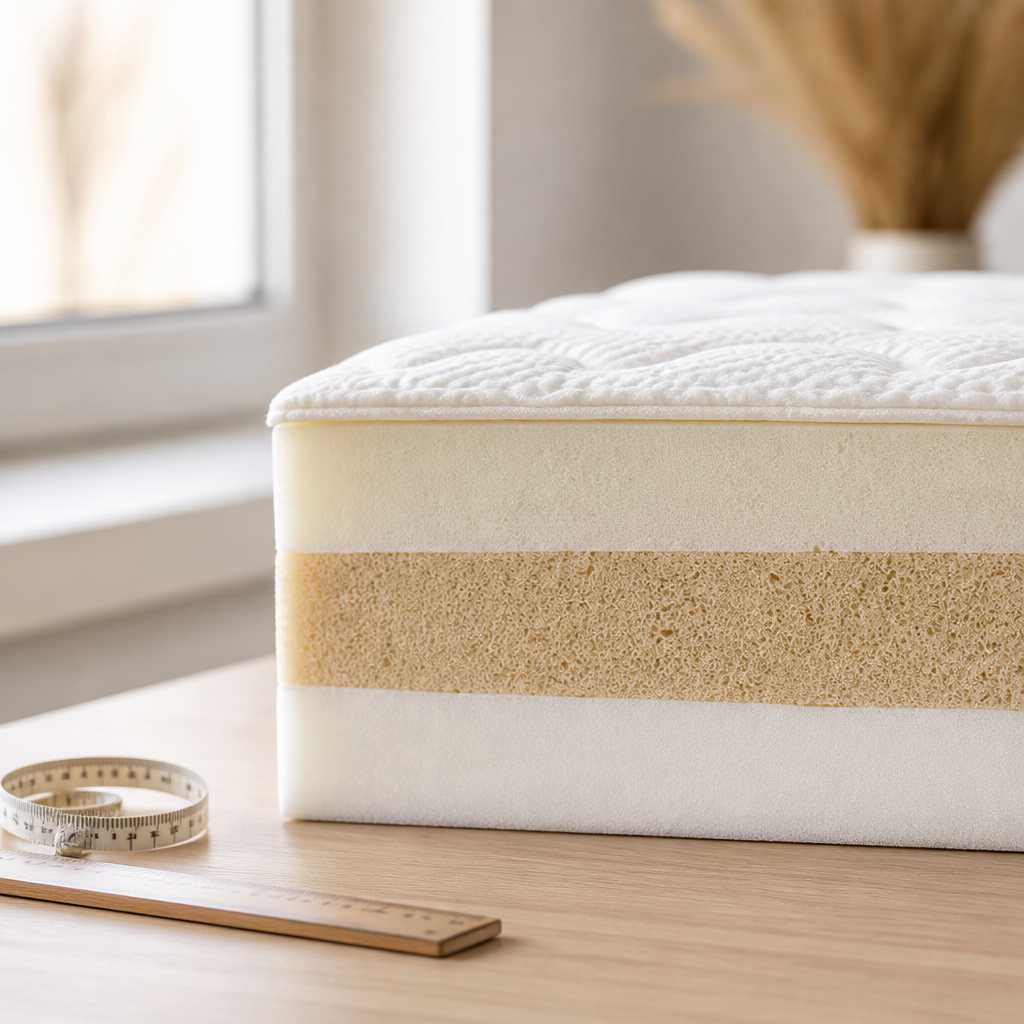
Simply put, more foam per unit of volume means more material that can resist breaking down under your body weight. When a foam is low density, its cells collapse more easily, and the surface begins to dip where you sleep most. That dip is usually where back pain starts, because the spine loses the level support it needs. In our experience, the comfort layer is the first place sagging shows up, not the base.
Why kilograms per cubic metre and pounds per cubic foot give different numbers
One pound per cubic foot is roughly 16 kilograms per cubic metre. A foam rated at 4 lb/ft³ therefore sits near 64 kg/m³, and a foam rated at 60 kg/m³ is about 3.7 lb/ft³. If you do not convert before comparing, you can mistake two nearly identical foams for a large difference, or assume a big number on one sheet beats a small number on another.
Our rule is simple: we write both figures on the sales paperwork. A seller who refuses to give you a density number at all usually has a reason, and that reason is rarely in your favor.
Density Versus Hardness: Why One Number Is Not Enough
Density alone does not tell you how a mattress will feel. Hardness, which describes the perceived firmness of the foam, is a separate measurement. A high density foam can be engineered to feel soft, and a lower density foam can feel firm, so the two numbers have to be read together.
How the 40 percent compression test works
According to the material we reviewed, hardness is measured by compressing a piece of foam to 40 percent of its original size. The force needed to do that is recorded in newtons. A rating of 70 to 100 N means it takes between 70 and 100 newtons of pressure to compress the sample, and the higher the figure, the firmer the foam feels.
Testing conditions and tolerances vary between manufacturers, so the hardness rating is not a one size fits all figure. Compare hardness most reliably within the same brand or the same testing standard, and be cautious when a seller compares their number with a figure taken from a different test.
Density tells you how much foam you are buying. Hardness tells you how that foam will feel under your hips at 11 p.m. You need both numbers before you decide.
Reading the density and hardness pair together
A dense comfort foam with moderate hardness tends to suit side sleepers, who need pressure relief at the shoulder and hip without a bed that feels like concrete. A dense foam with a firmer hardness rating tends to suit back sleepers, who need the lumbar area held up so the hips do not sink below the rib cage. Those are starting points, and your body weight and sleep position should still shape the final choice.
A low density foam with a soft feel can work for a guest room or occasional use. It will not hold up as a primary bed for years, and that is the mistake we see most often when budget shoppers try to save a little money on the comfort layer.
Pro tip: Ask the seller to write down the density and hardness of the comfort layer separately. If they only quote a firmness word like “medium” or “plush,” you do not have enough information to compare two beds fairly.
Density Ranges for Real Sleepers
Ranges vary by source, but one common way to sort memory foam is by pounds per cubic foot. A guide we reviewed groups high density as 4 to 6 lb/ft³, medium density as 3 to 4 lb/ft³, and low density as 2 to 3 lb/ft³. Those bands are useful as a starting point, not as a rulebook that fits every body.
The reasons behind the bands matter more than the labels. Higher density foam contours closely and holds its shape, while lower density foam feels softer on first contact and tends to wear down faster under repeated weight.
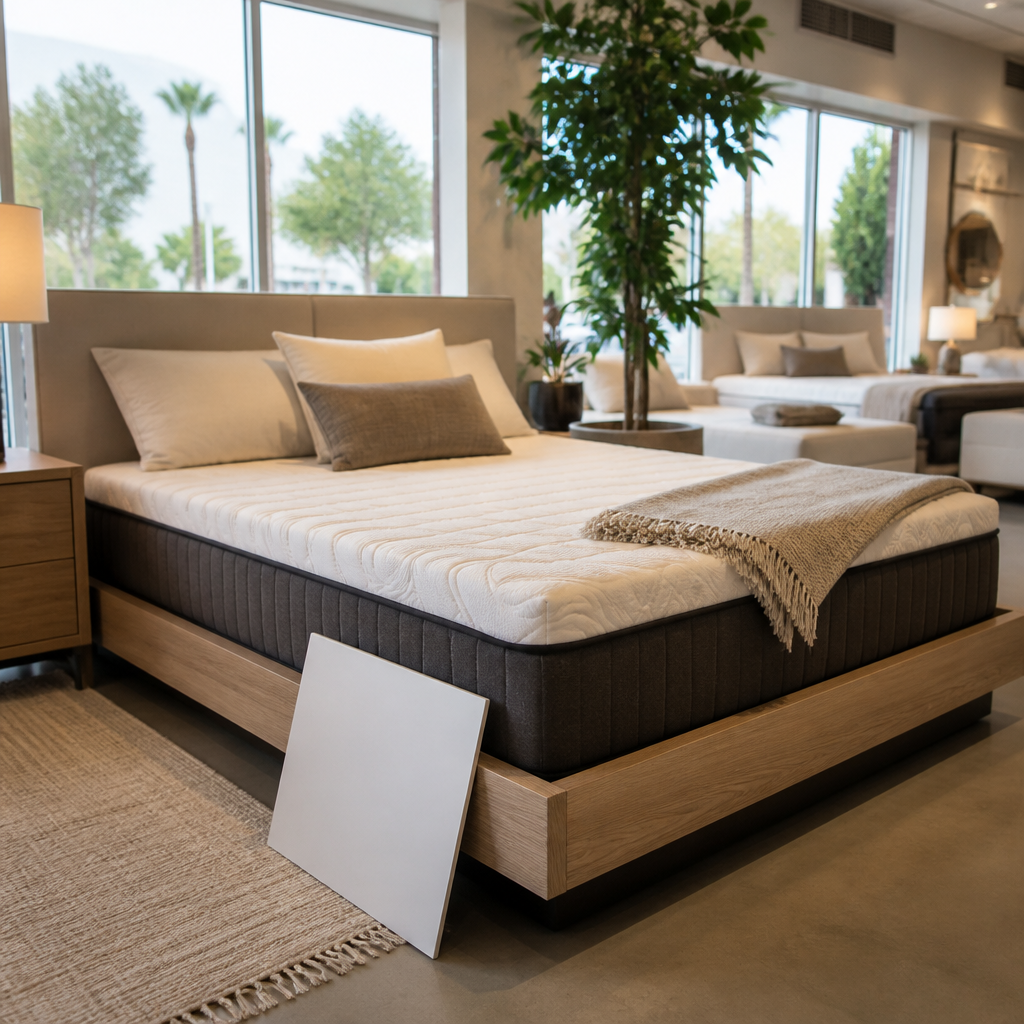
Density ranges for back and side sleepers
Back and side sleepers usually do best with a comfort layer in the medium to high range. Side sleepers need enough give at the shoulder and hip to avoid pressure points, while back sleepers need the lower back supported so the spine stays in a neutral line. A foam in the low band often fails both tests within a short time.
In practice, the customers who come in with back pain are rarely looking for a soft bed. They want a bed that feels comfortable on top and does not collapse underneath. That combination almost always comes from a denser comfort layer paired with a firm enough core.
Where a dense comfort layer goes wrong
Density is not a cure-all. A very dense, firm foam can create pressure buildup for lighter sleepers, and a thick dense layer can trap heat if the cover and airflow are not designed for it. Heavier adults often need higher density than lighter adults, so body weight belongs in the decision alongside the spec sheet.
A common mistake is buying the lowest density the budget allows, then blaming the mattress when the real problem was foam that collapsed within a few years. The bed did not fail suddenly. It failed slowly, and the owner did not notice until the back pain returned.
Durability and Cost Per Year of Sleep
A mattress is a multi-year purchase, so the honest comparison is cost per year of use, not the price on the tag. Sunset Bedding’s overview of foam density notes that density affects durability along with comfort and support, and that higher density foams tend to be more resilient. That matches what we see on the sales floor when customers return to replace beds they bought on price alone.
Here is a simple example. A less expensive bed that needs replacing in three years costs more per year than a denser bed that lasts much longer. Do the division before you celebrate a lower sticker price, because the cheapest bed is often the most expensive one over time.
Why higher density lasts longer
Dense foam has more material to absorb repeated compression. Over time, the structure of low density foam breaks down, and the result is a permanent dip that no amount of rotating the mattress will fix. Higher density foams resist that breakdown, which helps keep the spinal support you bought in the first place.
Durability also depends on how the bed is used. Heavy use, a child jumping on the edge, or a mattress placed on a sagging frame will shorten the life of any foam. Density gives you a stronger starting point, but it does not replace a solid foundation.
Paying for foam you cannot feel
Many shoppers judge a mattress in a few minutes of lying down in a showroom. That test tells you about surface feel and nothing about what the foam will do after years of nightly use. The layers you cannot see are the ones that decide how the bed ages.
Ask the sales team what sits under the top comfort layer, how thick each layer is, and what density each one carries. A straight answer is a good sign, and a vague answer about “premium foam” is a reason to keep looking.
Comparing Three Memory Foam Builds
To make the density bands concrete, here are three common memory foam builds we see in our showroom, using the ranges discussed above. Use the table as a starting point for your own comparison, not as a substitute for checking the actual spec sheet for each bed.
| Foam Build | Typical Density Band | Best Fit |
|---|---|---|
| Entry comfort foam | 2 to 3 lb/ft³ (about 32 to 48 kg/m³) | Guest rooms, light use, short-term bedding |
| Mid-range comfort foam | 3 to 4 lb/ft³ (about 48 to 64 kg/m³) | Combination sleepers who want balance and value |
| High-density comfort foam | 4 to 6 lb/ft³ (about 64 to 96 kg/m³) | Back and side sleepers who want long-term support and contouring |
The middle row is where many budget buyers find the best value, because it offers a reasonable balance between feel and cost. The top row is where durability and spinal support are strongest, and it is the better choice when back or hip pain is the reason you are shopping. Whichever row you favor, pair the density with a hardness rating before you decide.
A common mistake is comparing a thin topper with a thick comfort layer as if they were the same product. A thin layer of dense foam does not behave like a thick layer of medium foam, so always check the thickness along with the density.
Cooling Gel Layers and Density
Gel infused memory foam is marketed as cooler, and some gel formulations do help the surface shed heat. Gel is an additive, though, and it does not add structure. A gel infused foam with low base density will still sag, no matter how cool the label says it feels.
Keep that in mind when a salesperson leads with the cooling story. Hot sleepers have a real problem, but the fix starts with the base density and the airflow of the cover, not with a marketing word on the tag.
Why gel infusions do not add support
Support comes from the density of the base foam and the thickness of the comfort layer. Gel changes how the surface feels as it warms, not how much foam sits beneath your shoulders and hips. When you read a spec sheet, look for the density of the base foam first and treat the cooling claim as a secondary feature.
Cooling is still worth checking, especially if you wake up hot. Test the bed for a full night when you can, and pay attention to whether you wake with a warm, damp back or a neck that feels stiff from heat-related restlessness.
Asking for the foam spec sheet
A good seller can tell you the density, hardness, and thickness of every layer without hesitation. If the answer is a general description and nothing specific, it is fair to ask for the paperwork in writing before you sign anything.
Bring a list of questions and treat the answers as the real product. The spec sheet is the closest thing to a warranty on how the foam will age, and the people who can explain it clearly are usually the ones who know their stock.
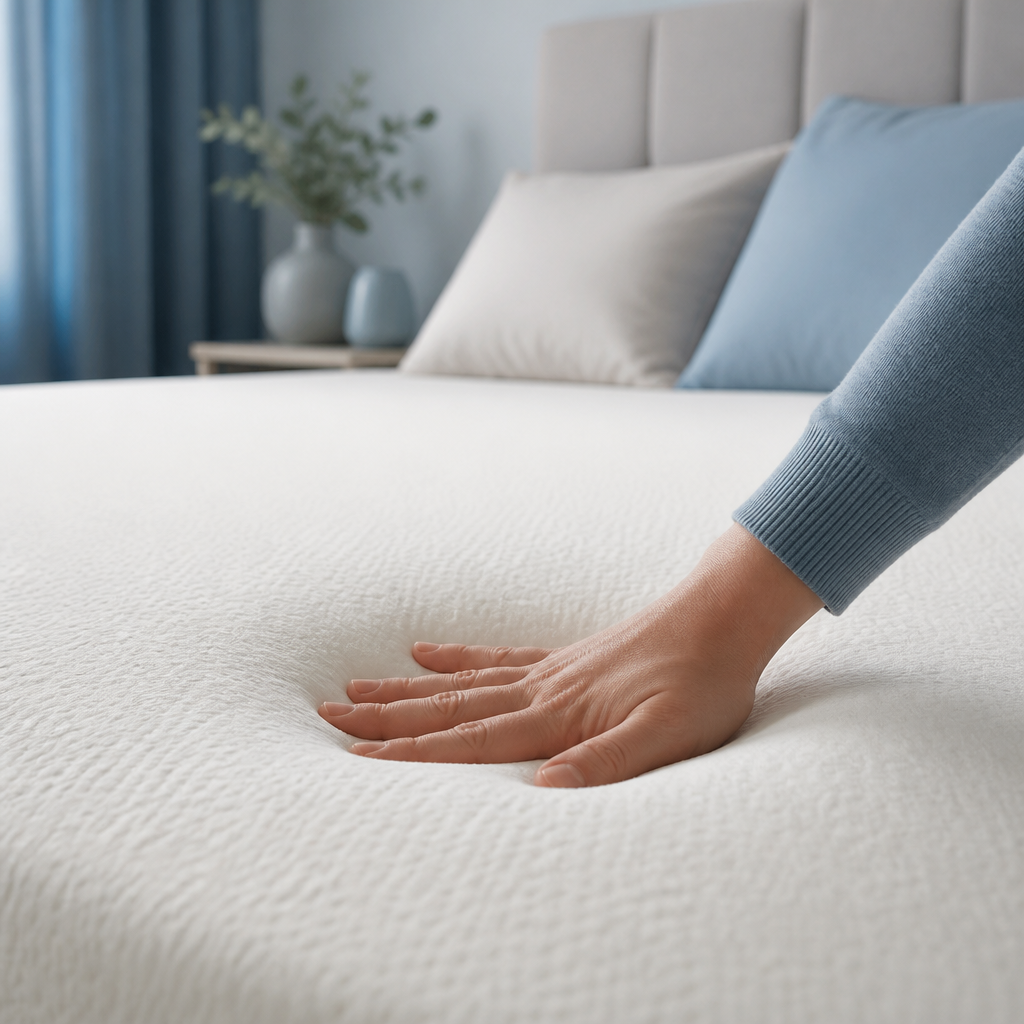
Pro tip: Sleep on the bed for a full night when you test it, and note whether you wake up hot or with pressure points. Heat trapped in a thick dense layer is one of the most common complaints we hear after a foam mattress is delivered.
Shopping for Memory Foam in Orange County
Our showroom serves Orange County and Anaheim, CA, and we built it around the spec sheet conversation. There are no commissioned sales associates here, so the advice you get is not tied to which bed pays the highest commission. Customers get personal, one-on-one attention and no pressure to buy on the first visit.
That matters for memory foam because the right bed depends on your body, your sleep position, and the problem you are trying to solve. A conversation that starts with density and ends with a clear recommendation is worth more than a fast sale.
Questions to ask before you buy
Bring a short list to the showroom. Ask for the density of the comfort layer in both units, the hardness rating, and the thickness of each layer. Then ask who handles delivery and what the exact delivery window will be.
We offer exact day-and-time delivery windows, and most orders are typically delivered within 24 to 48 hours. That timing matters when you are replacing a bed that is already causing neck, shoulder, or hip pain and you do not want to spend another week on a worn-out mattress.
Payment plans without a credit check
Many buyers in Orange County want a better bed but do not have strong credit, or they simply prefer to avoid credit cards. We offer no-credit-needed payment plans, including a 3-month purchase option available in California. Confirm the exact terms in writing and ask what happens if a payment is missed, so there are no surprises later.
Flexible payment should never replace the density check. A plan that spreads the cost over months is only a good deal if the bed still holds its shape after the last payment.
Matching density to your budget
Budget shoppers often assume that a low price means a low density bed. That is not always true. Our margins are small and our overhead is low, so we can offer high end memory foam mattresses for far less than box or chain stores charge. Density is still the first spec we check, whatever the price.
If you are furnishing a bedroom, our interior design service can help you match the bed with the rest of the room, so the mattress you choose fits both your body and the space around it.
Pro tip: Bring the problem you want to fix, such as morning neck stiffness, shoulder pressure, or hip pain, along with the age of your current mattress. A seller who listens to that first and then talks through density is giving you advice you can use.
Frequently Asked Questions
What is a good memory foam density for back pain?
For most adults with back pain, a comfort layer in the medium to high density range, roughly 3 to 6 lb per cubic foot, gives better spinal support than low density foam. Pair it with a hardness rating that keeps the hips from sinking too far.
Is higher density memory foam always better?
No. Higher density usually means more durability and firmer support, but very dense foam can feel too firm for light sleepers and can trap heat. The right density depends on body weight, sleep position, and comfort preferences.
How do I convert kilograms per cubic metre to pounds per cubic foot?
Multiply the kilogram figure by about 0.0624. For example, 60 kg/m³ works out to roughly 3.7 lb/ft³, which puts it in the medium band. Convert both numbers before comparing two spec sheets.
Does gel memory foam support better than standard memory foam?
Not by itself. Gel changes the cooling and surface feel, but support comes from the density and thickness of the base foam. Always check those figures before you decide based on the cooling claim.
Can I buy a memory foam mattress without a credit check?
We offer no-credit-needed payment plans, including a 3-month purchase option available in California. Ask for the full terms in writing before you sign, so you know exactly what each payment covers.
How long should a quality memory foam mattress last?
Lifespan depends on density, how the bed is used, and how it is supported, so no single number fits every bed. Higher density foams generally resist sagging for longer, so check the density first and treat any promised lifespan as a claim to verify on the spec sheet.
We would like to hear from you: what density number did you check before your last mattress purchase, and did the bed you chose change how well you slept?
References
- Guide to foam density, hardness, and firmness in mattresses
- Quality factors to check when choosing a memory foam mattress
- Overview of why mattress foam density matters and how it is measured
- Sleep Foundation guide to memory foam mattresses for 2026