


Neck Pain Every Morning? Audit Your Whole Sleep Setup
Waking up with a stiff, aching neck every morning is easy to blame on age or a bad night, but it is usually a setup problem you can track down. In one survey of older adults who had pain and had bought a mattress in the previous five years, almost 27% reported neck pain, which made it the third most common chronic pain in that group. A neck pain morning mattress check is the fastest way to find out whether your bed is the cause, but the mattress is only one of three parts holding your head in place all night. This guide shows you how to audit your mattress, pillow, and bed frame in order, so you stop guessing and start fixing the right thing.
Table of Contents
- Quick Takeaways
- Why Your Neck Hurts in the Morning
- Start With the Mattress
- Your Pillow Sets the Head Height
- Inspect the Bed Frame and Foundation
- Reading Your Morning Symptoms
- Comparing Your Fix Options
- Running a Two-Week Sleep Audit
- Shopping for a Mattress and Frame in Orange County
- Frequently Asked Questions
- References
Quick Takeaways
| Key Insight | Explanation |
|---|---|
| Check the mattress first | A surface that lets your hips sink drags the neck out of line with the spine for hours, so start by testing how your body sits on it. |
| Match the pillow to your sleep position | A pillow that suits a side sleeper usually pushes a back sleeper’s chin toward the chest, and the reverse is also true. |
| Inspect the frame and slats | A sagging base undoes a good mattress, so look for dips, creaks, and gaps before you blame the bedding. |
| Separate stiffness from lasting pain | Stiffness that eases within about an hour of moving around usually comes from position. Pain that lingers through the day deserves a medical check. |
| Change one variable at a time | If you swap the mattress, pillow, and frame in the same week, you will never know which change helped. |
| Treat numbness or arm symptoms as a medical issue | Tingling, weakness, or pain running down the arm is not a bedding problem, and a new pillow will not fix it. |
Why Your Neck Hurts in the Morning
Your neck carries the weight of your head for every hour you spend in bed, and during sleep you have no conscious control over how it sits. Whatever position your body settles into becomes a long, static load on the muscles, joints, and ligaments that hold your head up. By morning, that load shows up as stiffness, a dull ache at the base of the skull, or soreness between the shoulder blades.

Morning neck pain is a pattern, not a diagnosis. When customers come into our Anaheim showroom with a stiff neck, the first question we ask is how long the ache takes to fade. If it eases within about an hour of moving around, the tissues are reacting to a position held for most of the night. If it lingers through the day, the cause may be bigger than your bedding, and that is worth raising with a doctor.
Three parts of your bed decide whether your head stays level. The mattress sets the height of your body, the pillow sets the height of your head, and the frame or foundation determines whether the mattress holds its shape. A weak link in any one of them forces the neck to compensate, and the compensation is what you feel at 6 a.m.
Morning neck pain is usually a sign that your bed holds your head in the same wrong position for hours, not a sign that something is broken.
Start With the Mattress
Start with the mattress because it sets the level for everything above it. A bed that is too soft lets your hips sink and your shoulders drop, which pulls the neck out of line with the spine. A bed that is too firm pushes into the shoulder and the side of the head, so the neck tilts to compensate.
The National Council on Aging (NCOA) buying guide on mattresses for neck pain makes a similar point: medium-firm mattresses are generally the most comfortable for people with neck pain, and a mattress that is too soft may not be supportive enough for healthy spinal alignment. On our sales floor, the customers who wake up stiffest often describe a bed that felt fine for the first thirty seconds of lying down, then let them sink by midnight. Feel is not the same as support, and a showroom test needs to account for that.
Firmness that holds the spine level
Lie down in your normal sleep position and stay there for several minutes, not just a quick sit on the edge. Look at where your hips and shoulders land. A clear dip under the hips means the surface is letting your pelvis drop, and the neck will follow it down. If your shoulders are pinned so hard that your head tips upward, the surface is too firm for your frame.
We carry memory foam mattresses in Twin, Twin XL, Full, Queen, King, and California King sizes, and our mattresses are made in the USA. That matters less than fit, though. A mattress that is the right firmness but the wrong size for your room will still leave you guessing, so measure the bed space before you commit.
Why soft beds cause morning stiffness
Soft beds feel generous at first, which is why they are so hard to rule out. The trouble comes after a few hours, when the surface has conformed to your body and stopped pushing back. Your spine loses its natural curve, and your neck ends up angled to keep your eyes level with the ceiling.
In practice, a soft mattress is most likely to cause trouble for side sleepers and combination sleepers who shift during the night. If you wake up with the same sore spot on the same side each morning, check whether the mattress is sagging under that shoulder. Our guide to the signs of an old mattress causing neck and shoulder pain covers the wear patterns to look for.
Pro tip: Before you blame a new mattress, make sure you have slept on it for a full run of nights. Judging a bed by one night on a different pillow tells you very little.
Your Pillow Sets the Head Height
The pillow fills the gap between your head and the mattress, and that gap is different for every sleep position. If the pillow is too thick, your head tilts up and the neck stretches. If it is too thin, the head drops and the neck bends. Either mistake repeats hundreds of times a night, which is why a pillow that seems comfortable on the store shelf can still leave you sore.
For more detail on matching pillows to mattresses, read our guide on choosing the best pillow for neck pain. The short version is that a pillow cannot correct a mattress that sinks, and a mattress cannot correct a pillow that is the wrong height.
Side sleepers need more loft
Side sleepers have the widest gap between the ear and the mattress, so they need the most loft. The goal is a pillow that keeps the head in line with the spine, not one that looks plump in a photo. A common mistake is choosing a pillow that feels soft and fluffy, then discovering the head sinks too low by the second hour.
Watch whether your top shoulder is being pushed toward your ear. That is a sign the pillow is too low. Pair a supportive pillow with a medium-firm mattress so the shoulder has room to sit without collapsing the neck.
Back sleepers need a lower profile
Back sleepers need less height than side sleepers. A pillow that is too high pushes the chin toward the chest, which compresses the neck from the front and often leaves a tight, aching feeling along the back of the neck. Many back sleepers do better with a lower, contoured pillow that supports the curve of the neck without lifting the head off the bed.
Stomach sleepers have the hardest time with any pillow, because lying face down twists the neck to one side for hours. If you cannot break the habit, use the thinnest pillow you can tolerate, and consider sleeping on your side or back.
Inspect the Bed Frame and Foundation
The frame is the most overlooked part of the audit, and it is the one most people never check. A mattress rests on a base, and a base that flexes, sags, or shifts changes the shape of the mattress underneath you. Even a high-quality mattress will feel uneven if the support beneath it is failing.

Start with a simple visual check. Pull the sheets back and look at the foundation from the side. Dips, bowing, or a platform that visibly moves when you press on one corner are all signs the support is not doing its job. If you can see daylight through the frame where the mattress sits, your base needs attention before the bed does.
Slats and center support
Slats carry the mattress, and gaps between them that are too wide let the mattress sag into the space. Look for cracked, bent, or missing slats, and check whether the center support is actually touching the floor or a central rail. A queen bed with weak center support often sags in the middle, pulling the sleeper toward the low point all night.
If the frame is the weak link, replacing the mattress alone will not solve the problem. Repair the base first, or replace it, then reassess the mattress with the new support underneath.
Frame height and posture
Frame height changes how you get in and out of bed, and that movement puts strain on the neck when you rise. If you have to push up on your arms and crane your head to stand, the neck takes the load. A frame that sits at a comfortable height lets you roll to your side and sit up without jerking your head forward.
Our Queen Bedroom Furniture Sets start at $495 and include a bed frame, dresser, mirror, and one nightstand. If your current frame is failing, buying the frame and mattress together lets you match the support system instead of patching each piece separately.
Reading Your Morning Symptoms
Your symptoms tell you where to look next. Stiffness, soreness, and headaches on waking each point to a different part of the setup, and the pattern matters more than the intensity. Keep a short note of when the pain starts and when it fades, because that record will guide every decision that follows.
Stiffness that fades after you move
Stiffness that eases once you are up and walking usually reflects a position held for hours. This pattern points toward the mattress and pillow, especially if the stiffness is worse on one side. It is the kind of problem a better pillow height or a firmer, more even surface often resolves.
If the stiffness is also worse after a bad night on an unfamiliar bed, that is a clue that your home setup is not matched to your body. Compare how you sleep at home with how you sleep on a hotel or guest bed.
Pain that lingers or travels
Pain that stays with you all day, or that spreads into the shoulder, arm, or upper back, needs a different response. Tingling, numbness, weakness in the hand, or pain that shoots down the arm are signs to see a doctor, not signs to buy a new pillow. A bedding audit can rule out an obvious culprit, but it cannot diagnose a nerve or joint problem.
If you have had pain that keeps coming back, our guide to five signs an old mattress is causing neck and shoulder pain can help you decide whether the bed is the most likely cause before you spend money.
Comparing Your Fix Options
Once the audit points to a likely cause, choose the fix that matches it. Some providers and retailers will steer you toward the most expensive option first, but the cheapest effective change is often the right first step. The table below compares the three most common routes.
| Fix | Best When | Main Drawback |
|---|---|---|
| Replace the mattress | The surface sags under the hips or shoulders, or the bed no longer holds its shape | It costs more and must be tested for fit, firmness, and sleep position |
| Adjust or replace the pillow | You wake with the head tilted forward, back, or to one side, and the mattress feels even | A new pillow cannot correct a mattress that sinks |
| Repair or replace the frame | Slats are cracked or missing, the base creaks, or the center sags | It does nothing for a worn mattress, so check the bed surface too |
The order matters. Fix the foundation first, because it sets the shape of the mattress, then check the mattress, and only then adjust the pillow. Changing the pillow before the base is sound leaves you chasing a moving target.
Running a Two-Week Sleep Audit
A two-week audit gives you enough data to see a real pattern without turning sleep into a science project. Spend the first week recording how you feel, and spend the second week changing one thing at a time. The goal is a clear answer, not a perfect one.
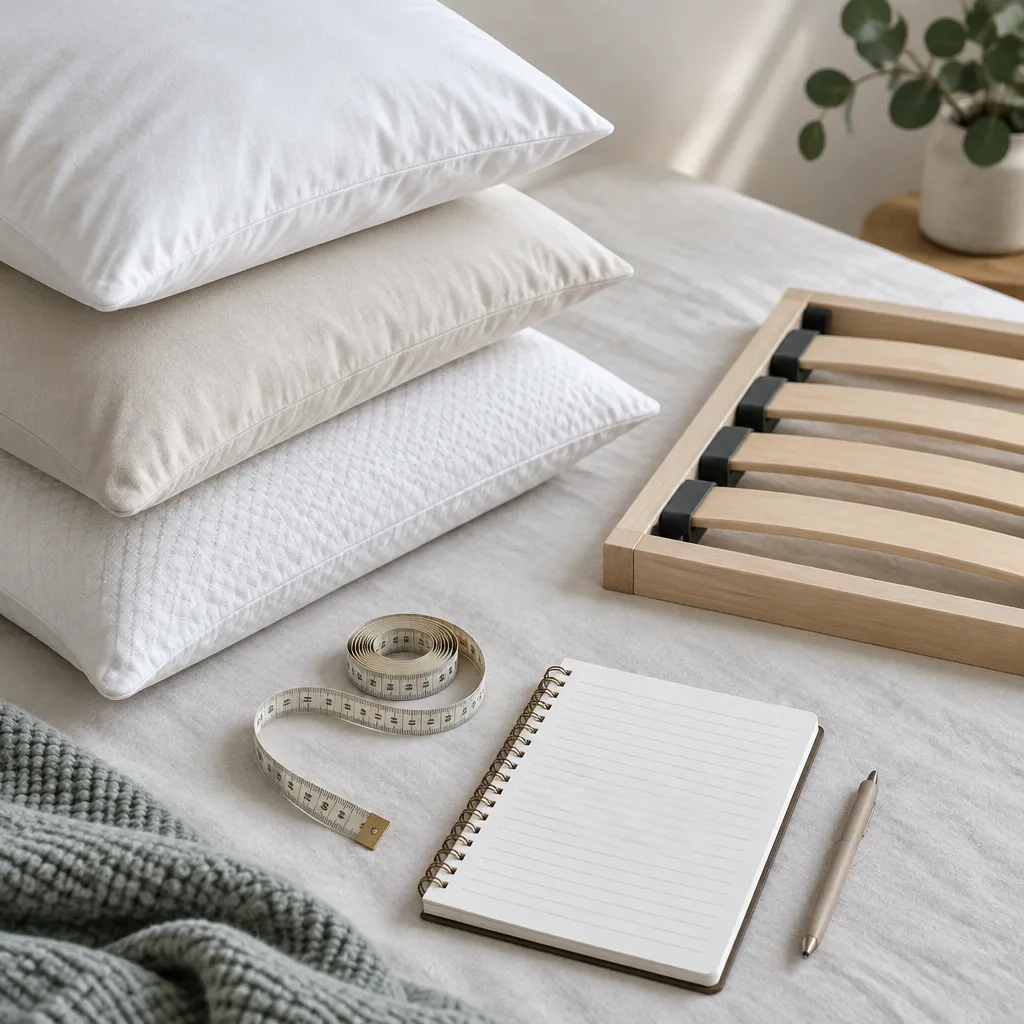
Keep the log simple. Write down your sleep position when you fell asleep, whether you woke with stiffness, how long it lasted after you got up, and any pain that lasted through the day. A few words per morning is enough, and the notes will show whether your mornings are improving.
Week one: record your baseline
Do not change anything during the first week, even if you are tempted. The baseline shows how your current setup performs, including the nights that feel better and the ones that feel worse. Note whether the bad mornings follow a particular position, a late night, or a change in your routine.
If you already know your pillow feels wrong, still record it as it is. The point is to measure the present setup before you alter anything.
Week two: change one variable
In week two, change one thing: the pillow height, the frame support, or the mattress position on the frame. If the mornings improve, keep that change and then test the next one. If nothing changes after a full week, move on to the next variable rather than piling on more changes.
Pro tip: Put a folded towel or a second pillow on the frame before you buy anything. If that quick test changes your mornings, you have found a useful clue about height, and you can shop with a clearer target.
Shopping for a Mattress and Frame in Orange County
If the audit points to a new mattress or frame, shop with the audit results in hand. Bring your notes about position, firmness, and the mornings that went wrong, because those details help narrow the options quickly. Our showroom is set up for one-on-one attention, so you can talk through the findings without pressure.
What the price points look like
Queen mattress sets start at $149, and King mattresses start at $199 and go up from there. Queen Bedroom Furniture Sets start at $495 and include a bed frame, dresser, mirror, and one nightstand. Sofas start at $189, Sectionals start at $449, and Dining Room Sets start at $199 if you are furnishing the rest of the room.
Pricing for individual mattresses is not shown on our website, because of our arrangements with the major manufacturers we buy from. The best way to see the current price on a specific model is to visit the showroom or call ahead. Our store is at 3030 E La Palma Ave, Anaheim, CA 92806, and you can book a one-on-one mattress appointment by calling 714-864-0531.
Payment and delivery terms
We offer no-credit-needed payment plans, and our 3-month purchase option is available in California. Under that option, the purchase is the same as cash, which means you do not pay a financing premium to spread the cost. The standard agreement offers 12 months to ownership, and customers who want to buy early under the plan can call 877-898-1970.
Delivery is scheduled to an exact day and time, with no four-to-six-hour window. Most items are received within 24-48 hours. We have not missed a delivery in five years, and we have no commissioned sales associates, so nobody is paid to push you toward a bigger purchase.
Pro tip: Bring your two-week audit notes to the appointment and ask the team to test the mattress in the position you actually sleep in, not just the position you use when you sit down to try it.
Frequently Asked Questions
Can a new mattress fix neck pain every morning?
It can, but only if the old mattress is the cause. A new mattress helps most when the old one sags under the hips or shoulders, or when it no longer holds its shape. If your pillow and frame are also off, a new mattress alone may not fully solve the problem.
How do I know if my pillow is the problem?
Check whether your head tilts forward, back, or to one side when you wake up, and whether the neck feels tight from one side. If the mattress feels even under your body and the pillow looks too high or too low for your position, the pillow is a likely cause.
Is a medium-firm mattress best for neck pain?
For many people, a medium-firm surface works best because it supports the spine without pushing into the shoulder. The NCOA buying guide notes that medium-firm mattresses are generally the most comfortable for people with neck pain. Your body weight and sleep position still matter, so test the feel before you buy.
How long should I test a new setup before judging it?
Give each change a full week of nights before you decide whether it helped. Changing several things at once makes it impossible to know which change made the difference. Use a short morning log to track stiffness and how long it lasts.
When should I see a doctor about neck pain?
See a doctor if the pain lingers through the day, spreads into the arm, or comes with numbness, tingling, or weakness. These symptoms need medical evaluation, and a bedding change cannot address them. Bring your morning log to the appointment so the doctor can see the pattern.
Do you offer payment plans for a mattress and bed frame?
Yes. We offer no-credit-needed payment plans, and our 3-month purchase option is available in California. The 3-month option is the same as cash, and the standard agreement offers 12 months to ownership. Call 714-864-0531 to talk through which option fits your budget.
Tell us which part of your sleep setup you changed first and whether your mornings improved, because your experience can help other Orange County readers decide where to start.
We would love your feedback and any insights you would share with others. What perspective would you add?
References
- NCOA buying guide on mattresses for neck pain and tested sleep quality findings
- AARP doctor-reviewed guide to mattresses for neck pain
- Forbes Personal Shopper guide to mattresses for easing neck discomfort